The central bank funding stigma
Yesterday the Federal Reserve Bank of New York published a brand new study about the stigma associated with banks borrowing from the central bank’s discount window. That was a nice coincidence following my response to Scott Fullwiler on the MMT and endogenous money theory, which seems to ignore this stigma (or at least to downplay its impact) and to consider that banks freely borrow from the central bank, providing a perfectly elastic high-powered money (reserves) supply. On the contrary, in my view, the stigma is one of the fundamental reasons that undermine the endogenous money theory.

Essentially, the NY Fed does not see much reason for this stigma to exist, but acknowledges that it does exist… I think they entirely forgot the possible impacts on a bank and its stakeholders of being considered illiquid, which I described in my previous post. Nonetheless, they made some good points (see below). A key point in my opinion is that banks are willing to pay more for other sources of funding than use the cheaper discount window.
The four main hypotheses they tested were very US-centric but interesting nonetheless. They found that:
- Banks inside the New York District were 14% less likely to experience the stigma than banks outside of the district (admittedly not that much difference)
- Foreign banks were 28% more likely to experience the stigma than similar US peers
- The largest the financial markets disruption, the higher the stigma
- The stigma does not decline when more banks utilise the discount window
Photo: MoneyAware
Risk-weighted assets and capital manipulations
As some of you might have noticed, the Bank of International Settlements published yesterday the final version of the Basel III leverage ratio (official report can be found here). This ratio is a measure of the capitalisation of a bank for regulatory purposes. I have already mentioned a few times those capital ratios. Since the first Basel regulations were introduced, capital ratios were based on risk-weighted assets (RWAs). Some of you might already be aware of my ‘love’ of RWAs… The leverage ratio, on the other hand, gets rid of RWAs.
I am not going to speak about the leverage ratio here. But about other two other related BIS studies that, in a way, legitimate the use of unweighted capital ratios. In January 2013, the BIS published a first analysis of market RWAs. They tried to estimate the variability of risk-weights associated to equivalent securities across banks. The BIS provided 26 portfolios of financial securities to 16 different banks and asked them to risk-weigh them according to their internal models. The results were shocking (but not surprising).
Banks mostly assess market risks using statistical Value-at-Risk models. The graph below shows the dispersion of the results provided by the banks’ VaR models. The results are normalised so that the median result is centred on 100%.

The dispersion is huge. Some banks judged portfolio 14 as being around 1000% riskier than the median bank’s perception of it (and I am not even talking about the most conservative one). Some comfort could be taken from the diversified portfolios (25 and 26), which are closer to real life portfolios. Nonetheless, even in those, variations are large enough to undermine the credibility of the risk-weights applied to them. The chart below demonstrates the capital requirements (in Euros) implied from the VaR results above for portfolio 25. Some banks would put aside more than twice the amount of capital than others would, for the same portfolio of securities.
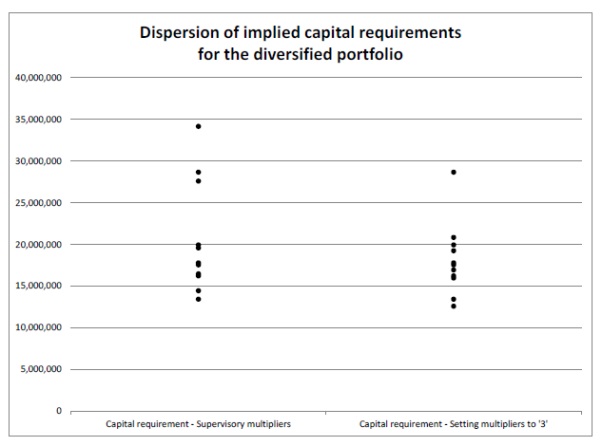
The BIS believed at that time that different local regulatory requirements were partially responsible for the results (such as some banks following Basel 2.5 and others Basel 2. I’m going to skip the details but Basel 2.5 pushes market RWAs up).
The BIS eventually published its final study on market RWA at the end of December. This time, all banks had implemented Basel 2.5. So most of the observed variation could only come from the banks’ internal model differences. What did they find?
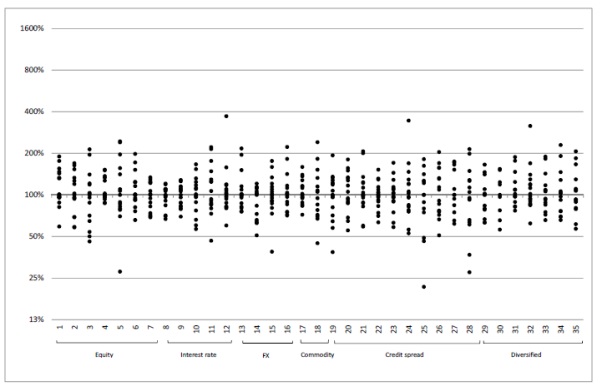
Not much difference. Variations were still huge. The resulting implied capital requirements (in thousands of Euros) for portfolios 29 and 30 were as follows:

Clearly, RWAs are unreliable. This questions the very utility of RWA-based regulatory capital ratios. How can one actually trust two different banks both reporting 10% Tier 1 ratios? One of them might in reality hold twice as little capital as the other one for what is actually the same risk level. Banks can easily game the system. Moreover, the FT was reporting yesterday that some banks were starting to report RoRWA (return on RWAs) instead of more traditional return on equity or return on assets. But those measures suffer from the exact same defects. While an unweighted leverage ratio is clearly not perfect, RWAs introduce far too much information distortion and even potentially exacerbate the business cycle. Time to get rid of them.
A response to Scott Fullwiler on MMT banking theory
Following my post about the problems with the MMT and endogenous money banking theory, Scott Fullwiler, one of its proponents, briefly (and very nicely) commented on it, suggesting that I was not criticising the theory and that we were in fact in agreement. I beg to differ.
Another commenter, JH, also left a link to a much more comprehensive article describing the theory, written by Scott (you can find it here). I recommend this article to everyone. It is a very interesting piece about banking, and Scott clearly demonstrates in it that his knowledge of the banking system is superior to most of his fellow economists.
I had started to write a fairly long post criticising the (few, but in my view, important) errors in Scott’s paper, but decided against it eventually, and deleted most of it to get directly to the main point. I could probably write a whole academic article about the topic but I have no idea how to get it published so won’t do it! (any advice appreciated though!)
Overall, I agree that Scott’s description of the lending process is largely accurate. However, I believe that the conclusions that seem to ‘naturally’ follow fall into a fallacy of composition. The endogenous money theory correctly assumes that the lending decision regarding a single loan is independent of the reserve status of the bank. However, the theory incorrectly assumes that this description also applies to lending as a whole.
The endogenous money theory correctly describes one-off borrowings from banks that temporarily lack reserves for some technical reasons. But this lack of reserves is only temporary as they have the necessary liquid holdings to generate new primary reserves. If banks can lend independently of their reserve status, it is because they have beforehand secured enough liquidity (= claims on primary reserves) to face settlements.
The fallacy of composition involves applying this reasoning to a bank’s aggregate lending. What happens as a one-off event cannot happen continuously, as it would progressively deplete the bank’s secondary reserves until it ends up only relying on interbank or central bank funding for marginal lending, assuming funding costs were maintained at a stable level. But they are not. The more secondary reserves fall, the more the bank’s ratings are cut, its cost of funding increases and its share price falls. At some point, not only the marginal increase in lending is not profitable anymore, but also the bank might have endangered its very existence by becoming borderline liquid resulting in all market actors getting hesitant to provide it with any fund.
Therefore, Scott is right when he says that we agree that banks are pricing-constrained. Indeed. But we disagree on the backstop mechanism. The endogenous view considers central bank funding (and pricing) as the backstop mechanism, against which banks are going to benchmark their new lending to assess its profitability (the interest rate spread) if other sources of funds are unavailable. As Scott says:
Borrowings and reserve balances can always be had at some rate of interest; the question is whether or not this rate of interest is one at which the bank can make a profit that provides a sufficient return on equity.
Scott here mainly refers to the lender of last resort, the central bank. This implies that the supply of reserve by the central bank is perfectly elastic at a given interest rate, and therefore entirely driven by demand. But he does not take into account the impact for a bank of being able to raise funds only from a central bank. Sure, a bank that cannot seem to find any reserve anywhere else can still usually borrow from the central bank. Nonetheless, this bank, is, well… screwed. It just committed suicide.
By overexpanding, it depleted its liquidity position (through adverse clearing) to such an extent that no market actor was willing to lend to it anymore. By admitting its new reliance on central bank funding for survival, it admits its failure. As I have already said in my previous post, this is why banks are doing their best to avoid using central banks’ facilities. Nonetheless, this bank has the possibility to regain market confidence: it can reduce its lending in order to generate new liquidity. This shows the limit of the endogenous money theory: in the medium-term, lending is indirectly reserve-constrained.
We can see that the benchmark against which banks assess the profitability of new lending isn’t the central bank’s rate. It is the various market rates. Even without the central bank changing its target rate, an overexpanding bank will inevitably be forced to contract its lending by market forces, and consequently, the money supply.
Endogenous money theorists could respond that financial markets act irrationally: there is no point in punishing banks that could actually obtain funding from the central bank, making liquidity risk irrelevant (at least as long as they are only illiquid and not insolvent). But investors have very good reasons: illiquid banks are usually either bailed-out or left to fail, with in either case serious consequences for shareholders, bondholders, and sometimes depositors. Think about Northern Rock and Bear Stearns. Those two banks were notoriously illiquid (rather than insolvent). You know what happened next.
Regarding the treatment of reserve requirements, I am not going to come back to the evidence from countries that actively use them as a policy tool. Nonetheless, the endogenous theory concludes that reserves are basically useless, except for interbank settlements and to comply with reserve requirements when needed (even cash withdrawals by customers are downplayed). I disagree; reserves are the most liquid asset banks can hold. When uncertainty increases in the markets and when even liquid securities suddenly become illiquid, banks increase their reserves holdings, which become precautionary reserves. Banks thus sacrifice some yield for liquidity. This does not mean that banks would not invest those reserves in loans or in securities should the economic conditions be normal.
I am going to stop here for today. There are a few other points I could have covered but as I said at the beginning of this post, this would require a 20-page article… Some of those include an overexpanding banking system as a whole (not just a single bank), the fact that, unlike what is implied in Scott’s article, banks are not maximising leverage, that leverage does seriously impact banks’ ratings, that deposits aren’t always the cheapest funding source, and even some details about banks’ regulatory capital calculations. Those are less important (or even very minor) points.
Update: See this post on the central bank funding stigma.
China as a spontaneous finance Frankenstein
China is an interesting case. Underneath its very tight government-controlled financial repression hide numerous financial experiments aimed at bypassing those very controls. The Chinese shadow banking system is now a well-known financial Frankenstein, with multiple asset management companies, wealth management products and other off-balance sheet entities providing around half the country’s credit volume. The more the government tries to regulate the system, the more financial innovation finds new workarounds and become increasingly more opaque.

Bitcoin is following this typical mechanism. China was one of the world’s most successful Bitcoin markets as local retailers and customers attempted to avoid government control and manipulation. In short, Chinese users liked that Bitcoin had fixed rules that could not be twisted by some corrupted officials. Bitcoin allowed them to transfer currency internationally almost without restriction. Its Chinese supporters felt free. Indeed, freedom and facilitation of transaction and saving is what drives most spontaneous financial innovations. Nonetheless, the love story couldn’t last as I have already described and the government launched a crackdown on Bitcoin in December.
Nonetheless, Bitcoin is coming back, the Frankenstein way. The FT reported today that local Chinese Bitcoin exchanges are now finding ways around new government rules. Surprising? It shouldn’t be. Governments around the world, a simple message: don’t underestimate your citizens. You’ll always run after them. Never ahead.
The issue is now that all those rules are pushing Bitcoin and other innovations even more into the shadows, making the whole system even more opaque and hard to analyse. For instance, while Chinese banks are now forbidden to clear Bitcoin transactions, a local platform route the money through its founder’s account. Some others have started to use voucher systems, essentially transferable claims on RMB accounts for people who want to buy and sell Bitcoins. Those vouchers effectively become claims on claims on money, or some sort of money substitutes redeemable on money substitutes (bitcoins) redeemable on money (USD)…
I personally don’t really welcome such evolutions. Government should stay away and not add further systemic risks to innovations already trying to figure out what their own limits are. As I recently said, learning is intrinsic to any system and should not be suppressed.
Blame the rich for the next asset bubble. Or not.
First of all, happy new year to all of you! Fingers crossed we don’t witness another market crash this year! 🙂
Indeed, credit markets are hot. Equity markets are also hot. The FT published an article yesterday with some striking facts about the ‘improvements’ in credit markets over the past couple of years. Some would say that it’s encouraging. I am not convinced…
Most credit indicators are close to or above their pre-credit crisis high. Sales of leveraged loans and high-yield bonds are above their pre-crisis peak. The average leverage level of US LBOs is back to 2006 level. Issuance of collateralised loan obligations is close to its pre-crisis peak. Even CCC-rated junk bonds are way above their previous peak. I’ve already mentioned some of those facts a few months ago.


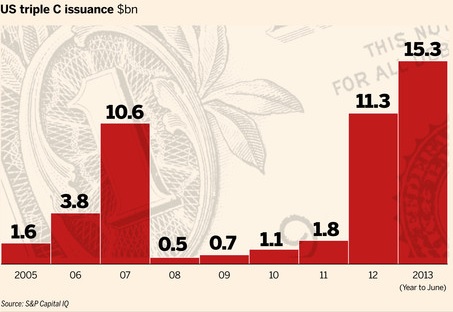
In a relatively recent presentation, Citi’s strategist Hans Lorenzen confirmed the trend: central banks are indirectly suppressing most risky investments’ risk premia. Most investors expect junk bonds’ spreads to tighten further or at least to stabilise at those narrow levels and emerging markets bonds and equities, as well as junk bonds are now among investors’ top asset classes .


My ‘theory’ at the time was that (see also here), if investors were piling in increasingly riskier asset classes, bringing their yield down to record low levels in the process, and nonetheless accepting this level of risk for such low returns, it was because current central bank-defined nominal interest rates were below the Wicksellian natural rate of interest. Inflation, as felt by investors rather than the one reported by national statistics agencies, was higher than most real rates of return on relatively safe assets. In order to see their capital growing (or at least to prevent it from declining), they were forced to pick riskier assets, such as high-yield bonds, which were not really high-yield anymore as a result but remained junk nonetheless. This would result in capital misallocation as, under ‘natural’ interest rate conditions, those investments would have never taken place. Thomas Aubrey’s Wicksellian differential, an indicator of the likely gap between the nominal and the natural rates of interest, was, in line with credit markets, reaching its pre-crisis high and seemed to confirm that ‘theory’.
Well, I now think that not all investors are responsible for what we are witnessing today. The (very) rich are.
This came to my mind some time ago while reading that FT piece by John Authers. This was revealing.
“Their wealth gives them scope to try imaginative investments, but they are terrified of inflation, even as deflation is emerging as a greater risk. That is in part because inflation for the goods and services bought by the very rich is running about 2 percentage points faster than retail inflation as a whole in the UK.” (my emphasis)
In the UK, real gilts’ yields were already in negative territory: adjusted by the (potentially underestimated) consumer price index, gilts were yielding around -1% early 2013. Savers were effectively losing money by investing in those bonds. Now think about the rich: by investing in such bonds, they would get a real return of around -3% instead.

Moreover, “71 per cent of respondents said they were more worried now about a steep rise in inflation than they were five years ago.”
Does it start to make sense? The cost of living I was mentioning earlier is increasing particularly quickly for the rich. And… they are the ones who own most financial assets. In order to offset those rising living costs, they naturally look for higher-yielding investments. And it is exactly what the FT reports:
“Their favourite asset classes for the next three decades are emerging markets equities, developed equities and agricultural land, in that order. Private equity comes close after farmland, while art and collectables were also a more popular asset class than any kind of bonds. […]
Hedge funds, as a group, have not fared well since the crisis. But wealthy investors preoccupied by inflation, and robbed of the easy option of bonds, are evidently disposed to give them a try, with an average projected allocation for the next three decades of 25 per cent. Meanwhile, the chance of a bubble in agricultural land prices, or in art, looks very real.”
Are the rich responsible for our current frothy markets then? Obviously not. They are acting rationally in response to central banks’ policies. Nonetheless, this raises an interesting question. Mainstream economics only considers a high aggregate inflation rate as dangerous. What about ‘class warfare’-type inflation? It does look like inflation experienced by one socioeconomic class could inadvertently lead to asset bubbles and bursts, despite aggregate inflation remaining subdued. This may be another destabilising effect of monetary injections on relative prices.
Granted, central banks possibly are on a Keynesian’s ‘euthanasia of the rentier’-type scheme in order to try to alleviate the pain of over-indebted borrowers (and/or to encourage further lending). But financial repression avoidance might well end-up coming back with a vengeance if savers’ reactions, and in particular, rich savers’, make financial markets bubble and crash.
Charts: FT (link above), Citi and Societé Générale
 Spontaneous Finance
Recent Comments