The importance of intragroup funding – The 19th century US experience
This is a follow-up post to my previous one on banks’ intragroup funding.
Financial and banking historians have known for a long time what the BoE believes it has ‘discovered’. A prime example of the importance of being able to move funds around (whether under the form of capital or liquidity) is the experience of US banking in the 19th century.
In the 19th century, the US was plagued by recurrent banking crises. This was mostly due to strict limitations on the development and growth of banks that basically isolated banks from each other. The result was known as ‘unit banking’. I am not going to enter into all the details (and this post mainly refers to the North of the US) but I strongly advise you to check the references at the bottom of this post.
The US’ political arrangements made it very difficult for the federal government to charter banks on a national basis, as the experiments of the First and the Second Banks of the United States demonstrate. States, on the other hand, could charter banks of issue within their borders to help finance the states’ expenditures. They also tended to forbid interstate branching in order not to leak out sources of funds to other states and artificially limit competition within their borders, as banking monopoly rents led to more abundant funding resources for the states (taxes could account for close to a quarter or even a third of total state financing). Many large cities ended up having a single bank at the very beginning of the 19th century.

The race for financing led states to charter increasingly more banks. However, new laws divided states into districts and allowed only a very limited number of banks to be chartered within each of them. Banks also did not have the right to open branches throughout the states. In the end, the whole banking system was completely fragmented in a myriad of small banks that enjoyed local monopolies.
From the 1830s, ‘free banks’ started to appear, a trend that accelerated following the 1837 banking crisis during which many banks failed throughout the country. This prompted a movement to increase competition in banking and access to credit for those who could not access the traditional, restricted, banking system. Free banks could be opened without any approval by state regulators. They still came to the funding need of state governments as the free banking laws required the full-backing of banknotes with high-quality securities, mostly government debt. Crucially, free banks were not allowed to branch. The previous system of larger banks that were constrained in their growth by their inability to open branch in other states, or simply in other districts, was progressively replaced by a system of a multitude of tiny ‘unit’ banks. In the end, the number of banks massively grew but unit banks often retained local monopolies. The federal government eventually tried to find ways to increase the number of nationally-chartered banks, but in the end those banks faced the same legal constraints that prevented free banks to branch.
There was political power behind those unit banks: because they couldn’t expand, unit banks were incentivised to lend to their local community even when times were tough (if they didn’t, they wouldn’t make any money and would fail anyway…). Banks were numerous (there were more than 27,000 banks in the US early-20th century, 95% of which had no branches…) but geographically isolated. As a result, they suffered from high levels of concentration in their loan books and deposit base, and were particularly badly hit by local economic problems. Liquidity risk was high and banks could hardly get hold of extra funds to face bank runs when they occurred.
Some banks tried to organise themselves into holding companies, owning several unit banks. However, the law prevented any financial or operational integration between various banks. The only thing they ended up sharing was a common ownership structure. A partial solution came up with the setup of clearinghouses, which basically settled interbank transactions, but also played the role of coordinator during local crises.
As a result of this poorly-designed banking structure, financial crises were recurrent: there were 11 of them between 1800 and 1914. Post-clearinghouses crises were nonetheless milder as clearinghouses allowed some liquidity to circulate.
Where does this lead us?
I described in my previous post how intragroup funding allows banking systems to remain more stable by allowing liquidity to circulate from stronger entities to weaker ones (this also applies to capital).
The 19th century US is an extreme example of what happens when you prevent this free movement of funds: a few banks fail and indirect contagion weakens even the stronger banks, leading to a systemic collapse. When banking groups are larger and free to move funds around, on the other hand, they have an incentive to reinforce their weaker links. Think about those 19th century ‘bank holdings’, which could not operationally integrate their various unit banks: the collapse of one of their ‘unit bank subsidiaries’ could potentially endanger the existence of all unit banks owned by that holding company through economic and financial contagion. Wouldn’t it be simpler to allow the transfer of funds from one unit bank to another to prevent any failure in the first place and actually reassure depositors that their banks are solid?
Unfortunately, current regulations aims at fragmenting and isolating national banking systems (and types of banks). This is likely to transform our globalised banking system into a mild version of what happened in the US, rather than into the stronger and more resilient systems that regulators hope to build. In the US, each unit bank had to maintain relatively high levels of capital and liquidity given their inherent weakness and lack of diversification. Was it enough to prevent crises? Not at all. This is in contrast with the Canadian experience, whose banking system comprised a few, very large, lightly regulated, branching banks. The Canadian banking system remained very stable throughout the period (and later).
More on 19th century Canada in a subsequent post.
Recommended readings:
- Charles A. Conant, A History of Modern Banks of Issue
- Charles Calomiris and Stephen Haber, Fragile by Design
- Christopher Whalen, Inflated: How Money and Debt Built the American Dream
- Milton Friedman and Anna Schwartz, A Monetary History of the United States
Update: I added one very important and great book to the list…
Is regulation killing banking… for nothing? The importance of intragroup funding
Last week, Barclays, the large UK-based bank, announced massive job cuts and asset reductions in its investment banking division which effectively signal the end of its ambition to compete with Tier 1 US banks. One of the main causes of that withdrawal is clear: regulations now make it a lot more costly to sustain capital market activities as Basel 3 has increased market risk capital requirements. But also, UK-specific rules, which advocate a ring-fencing of retail activities, also played a role in disadvantaging British banks. By ring-fencing retail banks from their sister investment ones, banks have to set up separate funding structures and look for separate funding sources, which makes it more expensive to fund investment banking divisions. Some would say that this is a good thing, as investment banking is “risky and caused the crisis”. This is wrong. In the UK and most of the world, it is mostly retail banks that failed as their asset quality strongly declined following the lending boom*.
This clampdown on investment banking is unfortunate, but wouldn’t undermine the whole banking system by itself. Regrettably, all aspects of banking are now being revisited and harmonised to please ‘out of control’ (in the words of one of my friends) regulators. Often though, the measures they take actually make banks weaker.
A brand new study published last month by the Bank of England itself (does the BoE read its own reports?) highlighted this very contradiction (see summarised post on Vox). What did it find?
The left-hand side panel of Figure 3 shows that interbank funding fell on average across our sample of BIS reporters by almost 30% between September 2008 and the end of 2009. Yet, in contrast, intragroup funding increased in the immediate aftermath of the collapse of Lehman Brothers and was stable for the remainder of the crisis period.
The contrasting behaviour of interbank and intragroup flows is not limited, however, to the recent global financial crisis. To see this, in the right-hand side panel of Figure 3, we present the distributional relationship across time between cross-border bank-to-bank funding and the VIX index.
We find that on average, between 1998 and 2011, interbank funding contracted by 2% during quarters when the VIX index was at an elevated level (upper-25th percentile), while during the same quarters intragroup funding expanded by over 2%. In the quarters when the VIX index was particularly low (lower-25th percentile), both intragroup and interbank funding expanded by approximately 4%.

This is self-explanatory. Globalisation of banking led to increased stability of funding flows. Local subsidiaries with excess liquidity were able to transfer some reserves to sister subsidiaries in other countries (or within the same country) and parent banks were also able to retrieve some of those excess funds in case they were under pressure at home. Banking system whose interbank funding comprises high share of intragroup experienced much lower drop in funding during the crisis**.
But, wait a minute… What’s the current regulatory logic? In the UK, the goal of ring-fencing is clear: ‘insulation’ (see the UK Commission report on banking reform). Globally, Basel 3 regulations now require each subsidiary of international banking groups to hold high levels of liquid assets and comply with a Net Stable Funding Ratio. By itself, this means that subsidiaries have a limited power to transfer liquidity intragroup even if they don’t need it at a given moment. Only liquidity/funding in excess of those (already high) limits could be transferred. In theory, local regulators can decide to supersede the original Basel framework. In practice, regulators are often reluctant to allow cross-border intragroup support, as they narrowly focus on their own national banking system and actually raise extra barriers, including capital controls. This happened during the crisis and potentially made it worse. This is what a BIS survey reported:
Respondents indicated that in some jurisdictions a banking parent can easily and almost without limit support its subsidiaries provided the parent continues to meet its liquidity standards. However, banking subsidiaries face legal lending limits on the amount of liquidity they can upstream to their parent even when they have excess liquidity.
Certain respondents claimed that these legal lending limits are inefficient when managing the liquidity and funding position of a banking group overall and advised that they expect future banking regulation to further institutionalise these inefficiencies. As such, in their view, subsidiaries will need a liquidity buffer for their own positions that the greater group is not able to use.
Furthermore, since the survey, financial nationalism has increased. As Bloomberg reported in February:
The Federal Reserve approved new standards for foreign banks that will require the biggest to hold more capital in the U.S., joining other countries in erecting walls around domestic financial systems.
In turn, European regulators threatened to retaliate… In short, regulators throughout the world, in an attempt to make their own financial system safer, are raising barriers and fragmenting the global financial system. But as this new research demonstrates, reducing the ability of banking groups to move funds around is weakening both global and domestic financial systems, not strengthening them.
I find bewildering that regulators don’t seem to get that logic. Let’s imagine that Bank X, based in the UK, has a subsidiary that shares the same name in the US. The US authorities believe that by making the US-based subsidiary stronger it will make it less likely to fail. Fair enough. Let’s now imagine that Bank X in the UK is experiencing difficulties and need to recover some funds located in its US sub to ensure its survival. Unfortunately, US rules prevent this transfer and Bank X effectively collapses. Do US regulators really believe that the US sub will remain untouched? Even if looking solid locally, this sub suffers massive reputational and operational damages from the collapse of its parent. This is likely to trigger a downward spiral, if not an outright bank run on those US operations. The original goal of the US authorities was thus self-defeating.
While such regulations can indeed make domestic subsidiaries look stronger, this isn’t the case on a consolidated basis. We have another fallacy of composition example here. None of those regulatory requirements can ever make banks fully crisis-proof. Consequently, when a truly large crisis strikes, healthy banks won’t be able to support their struggling sister banks, which can potentially even endanger their own existence through indirect contagion.
Even during non-crisis times, banks, and in turn economies, get penalised by those measures as banks’ cost of funding rises to reflect the inherent higher riskiness of each subsidiary/parent companies, making credit either more scarce and/or expensive.
Coincidentally, I am currently reading Fragile by Design, a new book by Calomiris and Haber, which argues that nations’ political frameworks influence the design of local banking systems and that some political arrangements (including the one in the US) are more prone to banking collapses. I guess current events are proving them right…
There are other, ‘counterintuitive’, solutions to stability in banking (which, guess what, involve less government intervention in banking, not more). Unfortunately, what we are currently witnessing is the sacrifice of competition in banking on the altar of instability… In the end, everybody loses.
* I should add that a lot of losses in investment banking divisions actually emanated from structured products (RMBS, CDOs) based on… dodgy retail lending. Nonetheless, those losses were marked-to-market and only few structured products outright defaulted (see also here). But mark-to-market losses, even when temporary, are enough to make a bank insolvent, according to current IFRS and US GAAP accounting rules.
** I am however a little curious about the claim of the authors that this result contradicts economic theory. I don’t know what ‘economic theory’ they are referring to, but those results look fully logical to me. Banking groups know what part of the group lacks liquidity. Because of reputational reasons, they have a clear incentive to transfer extra liquidity to struggling subsidiaries/divisions/holding companies. Letting a part of the group collapse is likely to trigger a dangerous chain reaction for the whole group.
Update: I modified the title of this post to more accurately reflect the content and the follow-up posts
News digest: P2P lending and HFT, CoCo bonds, Co-op Bank…
Ron Suber, President at Prosper, the US-based P2P lending company, sent me a very interesting NY Times article a few days ago. The article is titled “Loans That Avoid Banks? Maybe Not.” This is not really accurate: the article indeed mentions institutional investors such as mutual and hedge funds increasingly investing in bundles of P2P loans through P2P platforms, but never refers to banks. Unlike what the article says, I don’t think platforms were especially set up to bypass institutional investors… They were set up to bypass banks and their costly infrastructure and maturity transformation.
Some now fear that the industry won’t be ‘P2P’ for very long as institutional investors increasingly take over a share of the market. I think those beliefs are misplaced. Last year, I predicted that this would create opportunities for niche players to enter the market, focusing on real ‘P2P’.
A curious evolution is the application of high-frequency trading strategies to P2P. I haven’t got a lot of information about their exact mechanisms, but I doubt they would resemble the ones applied in the stock market given that P2P is a naturally illiquid and borrower-driven market.
The main challenge of the industry at the moment seems to be the lack of potential customer awareness. Despite offering better deals (i.e. cheaper borrowing rates) than banks, demand for loans remains subdued and the industry tiny next to the banking sector.
In this FT article, Alberto Gallo, head of macro-credit research at RBS, argues that regulators should intervene on banks’ contingent convertible bonds’ risks. I think this is strongly misguided. Investors’ learning process is crucial and relying on regulators to point out the potential risks is very dangerous in the long-term. Not only such paternalism disincentives investors to make their own assessment, but also regulators have a very bad track record at spotting risks, bubbles and failures (see Co-op bank below).
This piece here represents everything that’s wrong with today’s banking theory:
We know that a combination of transparency, high capital and liquidity requirements, deposit insurance and a central bank lender of last resort can make a financial system more resilient. We doubt that narrow banking would.
Not really… They also argue that 100% reserve banking would not prevent runs on banks:
The mutual funds of the narrow banking world would be subject to the same runs. Indeed, recent research highlights that – in the presence of small investors – relatively illiquid mutual funds are more likely to face exit in the event of past bad performance. […] Since the mutual funds would be holding illiquid loans – remember, they are taking over functions of banks – collective attempts at liquidation to meet withdrawal requests would lead to ruinous fire sales.
They misunderstand the purpose of such a banking system. Those ‘mutual funds’ would not be similar to the ones we currently have, which invests in relatively liquid securities on the stock market, and can as a result exit their positions relatively quickly and easily. Those 100% reserve funds would invest in illiquid loans and investors in those funds would have their money contractually locked in for a certain time. With no legal power to withdraw, no risk of bank run.
The FT reported a few days ago the results of the investigation on the Co-operative bank catastrophe. Despite regulators not noticing any of the problems of the bank, from corporate governance to bad loans and capital shortfall, as well as approving unsuitable CEOs and mergers, the report recommends to… “heed regulatory warnings.” I see…
The impossible sometimes happens: I actually agree with Paul Krugman’s last week piece on endogenous money. No guys, the BoE paper didn’t reveal any mystery of banking or anything…
Finally, Chris Giles wrote a very good article in the FT today, very clearly highlighting the contradictions in the Bank of England policies and speeches, and their tendency to be too dovish whatever the circumstances:
Mark Carney, the governor, certainly displays dovish leanings. Before he took the top job, he said monetary policy could be tightened once growth reached “escape velocity”. But now that growth has shot above 3 per cent, he advocates waiting until the economy has “sustained momentum” – without acknowledging that his position has changed. His attitude to prices also betrays a knee-jerk dovishness. When inflation was above target, he stressed the need to look at forecasts showing a more benign period ahead. Now that inflation is lower it is apparently the short-term data that matters – and it justifies stimulus.
So much for forward guidance… Time to move to a rule-based monetary policy?
A new regulatory-driven housing bubble?

There is nothing surprising at all in what’s happening. As I have already pointed out several times, Basel regulations are still incentivising banks to channel the flow of new lending towards property-related sectors. A repeat of what happened, again and again, since the end of the 1980s, when Basel was first introduced. I cannot be 100% certain, but I think this is the first time in history that so many housing markets in so many different countries experience such coordinated waves of booms and busts.
So far we’ve had two main waves: the first one started when Basel regulations were first implemented in the second half of the 1980s. It busted in the first half of the 1990s before growing so much that it would make too much damage. The second wave started at the very end of the 1990s, this time growing more rapidly thanks to the low interest rate environment, until it reached a tragic end in 2006-2008. It now looks like the third wave has started, mostly in countries where house prices haven’t collapsed ‘too much’ during the crisis.
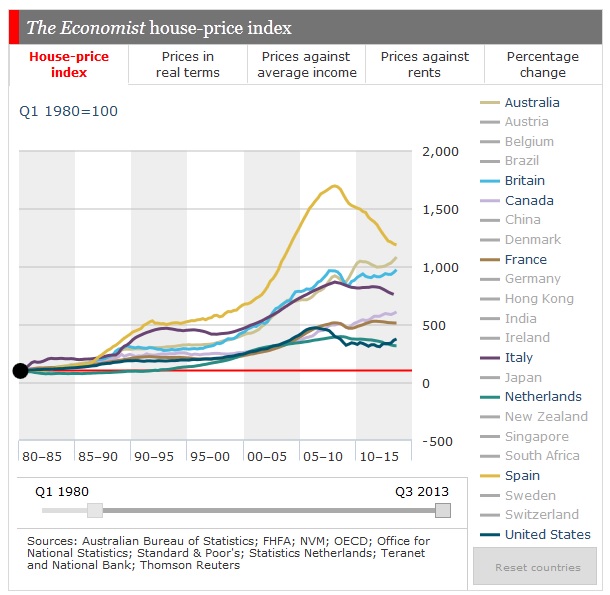
Sam Bowman was indeed right that lack of supply (through planning restrictions) is a real factor in driving up house prices in the UK. However, this cannot be the only issue at play here. A chronic lack of supply would lead to chronically increasing housing prices, not to wave-like variations, especially when those waves happen to be very well coordinated with those of other countries.
I still have to dig more in details into the data of each country, and I’ll do it in subsequent posts. For sure, some countries seemed to ‘skip’ one wave or to experience a mild one, but banking regulation is only part of the explanation. Local factors such as monetary policy, population growth, building restrictions, etc., are also important in determining local prices.
What’s interesting in the FT article is also the fact that a lot of countries have implemented macro-prudential policies over the last few years. Their effects on house bubbles seemed to have been close to nil… Indeed, low real interest rates compounded by regulatory-boosted mortgage lending supply still make housing an attractive asset class.
As long as this deadly combination remains in place, brace yourself for a recurring pattern of housing bubble cycles.
RWA-based ABCT Series:
- Banks’ risk-weighted assets as a source of malinvestments, booms and busts
- Banks’ RWAs as a source of malinvestments – Update
- Banks’ RWAs as a source of malinvestments – A graphical experiment
- Banks’ RWAs as a source of malinvestments – Some recent empirical evidence
- A new regulatory-driven housing bubble?
Felix Martin and the credit theory of money
I just finished reading a book that had been on my shelves for a few months, Money: The Unauthorised Biography, by Felix Martin (the book has only just been released in the US). Martin argues that our conventional view of money is wrong. Money isn’t a commodity used as a medium of exchange that evolved from the inconvenience of barter, but a system of mutual credit. Martin is not the first one to articulate this view, called the credit theory of money.

While overall Martin’s book is interesting, particularly for its historic descriptions and for bringing an ‘original’ view of the origins of money, it is plagued by a few problems and misinterpretations. Throughout the book, it feels like money, at least in its modern sense, is a ‘bad’ thing that is at the root of most of our current excesses, from inequality to financial crises. Perhaps, but the book never really discusses monetary calculation and economic efficiency. Money might have cons, but it also has pros. The fact that some ancient, very hierarchical – or even totally backward, societies were not using such ‘money’ is in no way something to be worried about…
Throughout his book, Martin seems to misinterpret former authors’ writings. Take Bagehot, whom Martin believes understood money and trust a lot better than most academic economists since then. Martin incorrectly reports Bagehot as saying that central banks should lend to insolvent banks. More importantly, he also didn’t seem to notice that Bagehot had never been a fan of the central banking system. In fact, Bagehot thought that system was not natural and even dangerous. This becomes a serious flaw of the book when Martin justifies his economic and reform ideas on a system that Bagehot himself saw as far from perfect.
Martin also seems to praise inflation without ever mentioning its downsides and the potential economic disruptions it can bring about. In turn, this leads him to praise… John Law. While John Law is most of the times seen as a model of economic mismanagement, Martin sees in him a ‘genius’, whose only faults was to have lived too early and to have believed in benevolent dictators:
Law’s system was ingenious, innovative and centuries ahead of his time.
To Martin, John Law’s system mainly failed because of… the vested interests of the old financial establishment! As with most other topics the book cover, I found this was a very selective reading of the historical facts.

This is the book’s main issue: it draws the wrong conclusions from a very superficial reading of history (including our latest financial crisis).
The book’s main thesis (admittedly, it’s also other people’s) suffers from the same problem. Why opposing credit theory of money and metalism? To me money can be both credit and commodity. This is not irreconcilable. Let’s suppose you provide me with a service or a product. The consequence of this transaction is that I am in credit to you. From there, what can you do? To settle the transaction, you can either accept one of my products or services. This is barter. Or you could use my ‘debt’ to you (my IOU) to purchase another product from someone else. However, in order to accept the ‘debt transfer’, the other person needs to make sure that my credit is good (i.e. that I will close the transaction at some point) in order to reduce the probability of losses (i.e. credit risk). This other person can further transfer my IOU, which ends up serving as money in a chain of transactions. Nevertheless, settlement (i.e. debt cancellation) is still expected at some point, and with no generally accepted medium of exchange, this settlement is similar to barter. This system still suffers from lack of granularity and from the double coincidence of wants problem.
Enter commodities. Excluding its barter-like issues, the process described above works, but involves credit risk. Developed societies discovered a way to reduce this credit risk to a minimum: a direct settlement of the IOU against what we view as the same value of a granular, easily transferable and measurable commodity. Think about it: you can either take the risk that my IOU will not be transferable any further or that I will fail to close the transaction, or you can settle the transaction directly by accepting some sort of commodity in exchange, which makes credit risk entirely disappear. But the system remains a system of credit: the only difference now is that IOU transfer chains end directly after the first transaction. This is still valid nowadays: everybody still says “how much do I owe you?” in order to pay for a good in store*.
(Note: of course if my credit is good, my IOU could still be transferred and ‘used’ as a medium of exchange, but would still merely remain a claim on the same easily transferable commodity.)
Strangely, Martin seems to downplay the settlement issue. He takes the Yap islands as an example of a pure system of credit money. But this is not accurate: Martin himself says that locals eventually settle their mutual debt using stone money (the fei/rai)!
I ended up quite confused about the book. It is hard to figure out what Martin really believes. Some of his proposals, such as money that would be some sort of state equity, look unworkable and closer to statist dreams than economic freedom; although this shouldn’t be surprising, as Martin never really questions the state, regulators and central bankers, and blindly accepts the Keynesian criticism of Say’s law. Money is more a history book than an economics book, but whether this is financial history or monetary theory you’re looking for, there is already a lot more comprehensive out there.
*The story I just described is essentially similar to Carl Menger’s theory of the origins of money. However, I added in a new factor: credit risk.
New research on banking
New York Fed researchers published new papers on banking over the past few months on the Fed’s blog Liberty Street Economics.
The first one, titled Stability of Funding Models: an Analytical Framework, is summarised through two different blog posts (here and here). The researchers present a banking model that graphically illustrates the factors that influence the risk of a bank becoming insolvent or illiquid (namely: low asset returns, high leverage, loss of funding (short-term debt maturity profile), asset encumbrance…).
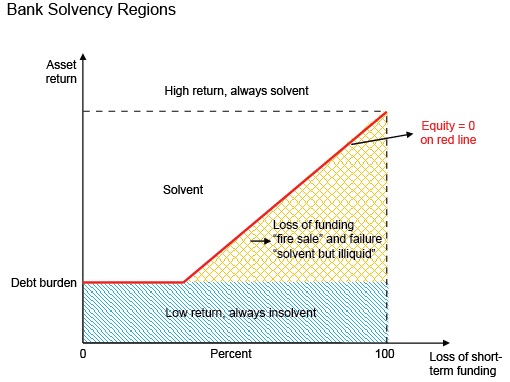
Nothing ground breaking. The model simply graphically represents what all banks’ analysts already know. But the principle is interesting. They also published an interactive model you can play with to simulate your own bank (here). I think the internal microeconomic impacts of the firm are also downplayed here: cost efficiency also plays a crucial role, ceteris paribus. Two banks’ asset returns (and in turn revenues), funding profile (and in turn net interest margin) and leverage could be the same, but the bank with the higher cost/income will have a lot less financial flexibility to absorb the exact same asset impairments when they arise and as a result presents a higher risk of insolvency.
The second piece of research, titled Do “Too-Big-to-Fail” Banks Take On More Risk? (see related blog post here), aims at analysing the influence of being classified as ‘systemically important’ on risk-taking. The report concludes that:
The results of our investigation show that a greater likelihood of government support leads to a rise in bank risk-taking. Following an increase in government support, we see a larger volume of bank lending becoming impaired. Further, and in line with this finding, our results show that stronger government support translates into an increase in net charge-offs. Additionally, we find that the effect of government support on impaired loans is stronger for riskier banks than safer ones, as measured by their issuer default ratings. Our findings offer novel evidence that government support does play a role in bank risk-taking incentives.
Fed researchers decided to use the rating agency Fitch’s Support Rating Floor as an indication of sovereign support, as most other rating agencies do not distinguish between institutional/parental and sovereign supports in their rating uplift. This is Fitch’s methodology, which you can find in their financial institutions rating criteria here (gated but free registration):

Nothing very surprising here either, but this research adds to the increasingly large literature that underlines the benefits (and the risks) of being a large (and possibly government-linked) bank. Artificially cheaper funding and riskier behaviour pushes the banking system away from its equilibrium state, which is supposed to reflect savers’ intertemporal preferences. This, combined with inaccurate central bank monetary policy and regulatory-distorted interest rates, is a definitive recipe for the misallocation of capital on a massive scale. No surprise financial and economic crises are so recurrent.
Finally, other Fed employees developed yet another liquidity measure, the liquidity stress ratio. I’m not sure about its usefulness to be honest as well as some of the conclusions that the authors draw from some of the spurious correlations they calculate. Take the following chart for example:

From this, the authors conclude:
The positive relationship [between capitalisation and liquidity stress ratio] may indicate that when banks are less vulnerable to undercapitalization, they take more liquidity risk. In other words, capital and liquidity may act as substitutes.
Really? Take the red line off the chart above and you end up with no clear pattern at all. Some banks play it safe; some others are willing to take on more risk; some are in between. This seems to me to be a clear case of mathematical regression interpretation abuse.
On another platform, Vox, a group of economists have come up with an interesting experiment. They found that
Economic linkages between banks give rise to contagion of deposit withdrawals across banks, especially when depositors are aware of these economic linkages. Systemic risk due to the contagion of panic-based deposit withdrawals is thus likely to be more acute for banking systems characterised by clusters of domestic banks which share the same business model (e.g. cajas in Spain or Sparkassen/Volksbanken in Germany).
This is very interesting. However, their recommendation is way off:
For regulators this accentuates the question of how to monitor and regulate economic linkages between banks stemming from similar exposures, in order to mitigate financial fragility and to encourage greater diversity in the financial system.
Are they aware that regulators have been doing the exact opposite of their recommendation for many, many years? Regulations have been trying to harmonise business models since the 1980s, when Basel regulations were first implemented. Moreover, regulators now try to influence banks’ internal organisation and structure to comply with what they see as adequate. The result of all those policies is an increasing lack of diversification between banks. You want more diversity in the financial system? Then tell regulators to back away.
PS: Martin Wolf had a piece in the FT this week in which he came on favour of… 100% reserve banking. That’s right. That was a little bit of a surprise to say the least. Izabella Kaminska discussed it here, though she seems again to get mixed up between various terms and definitions, and Frances Coppola had a good article criticising Wolf’s idea (though I don’t entirely agree with everything she says).
Greenspan put, Draghi call? (guest post by Vaidas Urba)
(This is a monetary economics guest post by Vaidas Urba, a market monetarist from Lithuania. He has previously appeared at The Insecurity Analyst blog and TheMoneyIllusion. You can follow him on Twitter here)
Greenspan put, Bernanke put – everybody uses these expressions half-jokingly to describe monetary policy and asset prices. Ricardo Caballero and Emmanuel Farhi have proposed a very serious classification of policy tools, distinguishing between monetary puts and calls. According to Caballero and Farhi, policy puts support the economy in bad states of the world, while policy calls support the economy in good states of world. There is much to disagree with in their “Safety Traps and Economic Policy” paper, but their definition of policy puts and calls is very useful.
QE1 and ARRA stimulus in 2009 are examples of policy puts. On the other hand, QE3 and Evans rule are primarily policy calls. Evans rule supported expectations of low interest rates in good states of the world, while QE3 compressed the term premium by reducing the risk of bond market volatility during the recovery. Policy calls are riskier than policy puts. Evan’s rule increased the risk of suboptimally low interest rates during late stages of recovery, while QE3 increased the risk of losses in Fed’s portfolio. Indeed, on March 1, 2013 Bernanke indicated that the estimated treasury term premium is negative. The Fed has walked back from policy calls. Tapering has restored the bond term premium to more normal levels, and the Fed has replaced the Evans rule with a more vague guidance. Bernanke call was replaced by Yellen put.
The Fed has used both monetary puts and calls, but the ECB has never used policy calls, and is not planning to use them. The policy of the ECB was a succession of impressive policy puts. Temporary liquidity injection in August 2007 has addressed the liquidity panic. Full allotment in October 2008 has placed a floor on the functioning of euro and dollar money markets. Three year LTROs in 2011 have prevented Greece’s default from becoming Lehman II. OMTs are out-of the money policy puts – they were never activated. Forward guidance is a policy put too, the ECB describes it as being all about “subdued outlook for inflation and broad-based weakness of the economy”, and low rates are signalled in bad states of the world without affecting interest rate expectations in good states of the world.
On further weakness the ECB is likely to start QE. Executive Board member Benoit Coeure has recently given us a glimpse of likely modalities of QE in his “Asset purchases as an instrument of monetary policy” speech. Coeure has stressed the continuity of ECB’s approach, he also said that “asset purchases in the euro area would not be about quantity, but about price”, and the ECB will use the yardstick of “the observable effect of our operations on term premia”. Presumably, the intent of QE will be to reduce term premia that are unduly high (policy put), and not to recreate boom conditions in financial markets by driving term premia to excessively low levels (policy call).
The Eurozone economy is very far away from any sensible macro equilibrium, and monetary call would be a very sensible step to take. Unfortunately, a blocking minority exists for any explicit decision. However, Draghi could communicate an implicit policy call by signalling the existence of majority coalition which would block a premature interest rate increase. The rate hike of 2011 was unanimous, so the bar is high for any such communication. Draghi’s talk of “plenty of slack” is a step to the right direction, but stronger and clearer words are needed to persuade the markets that ECB’s reaction function has changed unrecognizably since 2011.
What most people seem to have missed about high-frequency trading
I finished reading Michael Lewis’ new book Flashboys last week. I wasn’t a specialist of high-frequency trading (HFT) at all, so I found the book interesting. Overall, it was an easy read. Perhaps too easy. I am always suspicious of easy-to-read books and articles that supposedly describe complex phenomena and mechanisms. Flashboys partly falls in that trap. Lewis has a real talent to entertain the reader. He unfortunately often slightly exaggerates and attacks the HFT industry without giving them the opportunity to respond. More annoyingly, the whole book reads like a giant advertising campaign for IEX, the new ‘fair’ exchange set up by Brad Katsuyama. In the end, I was left with a slightly strange aftertaste: the book is very partisan. I guess I shouldn’t have been surprised.

The book, as well as HFT, have been the topic of much discussion over the past few weeks*. I won’t come back to most of those comments, but I wish here to highlight what many people seem to have missed. Lewis, as well as many commenters, drew the wrong conclusions from the recent HFT experience. They misinterpret both the role of regulation and the market process itself.
What is most people’s first answer to the potential ‘damage’ caused by HFT? Regulation. I would encourage those people to read the book a second time. Perhaps a third time. This is Lewis:
How was it legal for a handful of insiders to operate at faster speeds than the rest of the market and, in effect, steal from investors? He soon had his answer: Regulation National Market System. Passed by the SEC in 2005 but not implemented until 2007, Reg NMS, as it became known, required brokers to find the best market prices for the investors they represented. The regulation had been inspired by charges of front-running made in 2004 against two dozen specialists on the floor of the old New York Stock Exchange – a charge the specialists settled by paying a $241 million fine.
Bingo.
Until 2007, brokers had discretion over how to handle investors’ trade orders. Despite the few cases of fraud/front-running, most investors didn’t seem to particularly hate that system. In a free market, investors are free to change broker if they are displeased with the service provided by their current one. At the very least, nothing seemed to really justify government’s intervention to institutionalise and regulate the exact way brokers were supposed to handle trade orders. In fact, when government took private discretion away, investors started feeling worse off. This is the very topic of the book (though Lewis didn’t seem to notice): government and regulation created HFT.
Brad Katsuyama sums it up pretty well (emphasis mine):
I hate them [HFT traders] a lot less than before we started. This is not their fault. I think most of them have just rationalized that the market is creating inefficiencies and they are just capitalizing on them. Really, it’s brilliant what they have done within the bound of regulation. They are much less a villain than I thought. The system has let down the investor.
Brad is definitely less naïve than Lewis, who still believed in the power of regulation throughout his book**:
Like a lot of regulations, Reg NMS was well-meaning and sensible. If everyone on Wall Street abided by the rule’s spirit, the rule would have established a new fairness in the U.S. stock market.
Meanwhile, David Glasner questioned the ‘social value’ of HFT on his blog:
Lots of other people have weighed in on both sides, some defending high-frequency trading against Lewis’s accusations, pointing out that high-frequency trading has added liquidity to the market and reduced bid-ask spreads, so that ordinary investors are made better off, not worse off, as Lewis charges, and others backing him up. Still others argue that any problems with high-frequency trading are caused by regulators, not by high-speed trading as such.
I think all of this misses the point. Lots of investors are indeed benefiting from the reduced bid-ask spreads resulting from low-cost high-frequency trading. Does that mean that high-frequency trading is a good thing? Um, not necessarily.
I believe that here it is Glasner who completely misses the point. Should we blame HFT traders from exploiting loopholes created by regulation? Economists are better placed than anyone to know that people respond to economic incentives. The resources ‘wasted’ by HFT on ‘socially useless informational advantages’ emanate from government intervention. It is highly likely that HFT would have never developed under its current form should Reg NMS had not been passed. What we instead witness is another case of regulatory-incentivised spontaneous financial innovation.
The second problem lies in the fact that most people seem to have become particularly impatient and dependent on short-term (and short-sighted) regulatory interventions. They spot a new ‘problem’ in the way markets work (here, HFT) and highlight it as a ‘market inefficiency’. This evidently cannot be tolerated any longer and regulators need to intervene right now to make markets ‘fairer’ (putting aside the fact that they were the ones who created this ‘inefficiency’ in the first place).
This demonstrates a fundamental misinterpretation of the market process. Markets’ and competitive landscapes’ adaptations aren’t instantaneous. This allows first movers to take advantage of consumers/investors demand and/or regulatory loopholes to generate supernormal profits… temporarily. In the medium term, the new economic incentives attract new entrants, which progressively erode the first movers’ advantage.
This occurs in all industries. Financial firms are no different (assuming no government protection or subsidies). And, despite Lewis’ outrage at HFT firms’ super profits, the fact is… that the mechanism I just described has already applied to them. It was reported that the whole industry experienced an 80% fall in profits between 2009 and 2012 (which Tyler Cowen had already ‘predicted’ here).
Besides, the story the book tells is a pure free-market story: a group of entrepreneurs wish to offer an alternative platforms to investors who also decide to follow them. There is no government intervention here. The market, distorted for a little while, is sorting itself out. Even the big banks see the tide turning and start switching sides (Goldman Sachs is depicted in a relatively positive light in the book). Lewis’ book itself is also part of that free-market story: the finger-pointing and informational role it plays is a necessary feature of the market process. To me, this demonstrates the ability of markets to right themselves in the medium-term. Patience is nevertheless required. It unfortunately seems to be an increasingly scarce commodity nowadays.
There was a very good description of HFT and its strategies published by Oliver Wyman at the end of last year (from which the chart below is taken). Surprisingly, they described HFT’s strategies and the effects of Reg NMS before the publication of Lewis’ book, without unleashing such a public outcry…

* See some there: FT’s John Gapper, The Economist, David Glasner, Noah Smith, Zero Hedge, Tyler Cowen (and here), ASI’s Tim Worstall, as well as this new paper by Joseph Stiglitz, who completely misinterprets the market process. See also this older, but very interesting, article by JP Koning on Mises.org on HFT seen through both Walrasian and Mengerian descriptions of the pricing process.
I also wish to congratulate Bob Murphy for this magical tweet:

** This is also despite Lewis reporting this hilarious dialogue between Brad Katsuyama and SEC regulators (emphasis his):
When [Brad, who had just read a document describing how to prevent HFT traders from front-running investors] was finished, an SEC staffer said, What you are doing is not fair to high-frequency traders. You’re not letting them get out of the way.
Excuse me? said Brad
And to continue saying that 200 SEC employees had left their government jobs to go work for HFT and related firms, including some who had played an important role in defining HFT regulation. It reminded me of this recent study that showed that SEC employees benefited from abnormal positive returns on their securities portfolios…
News digest: central bank independence, TBTF and ironic regulators
I’m quite busy at the moment so not many updates here. However I am almost done with Michael Lewis’ new book on high-frequency trading Flashboys. I’ll surely write something about it soon.
The FT had this week an interesting and quite comprehensive article on fintech and new financial start-ups (not sure they all qualify as ‘fintech’ though…). It’s a good introduction for those who don’t know what’s going on in the sector.
On the other hand, about a week ago, Martin Wolf had one of the worst articles on the recent BoE paper on money creation I have had the occasion to read. It looks like Wolf is oblivious to the intense debate on the blogosphere (and elsewhere) that was triggered by the publication of this controversial, and flawed, paper. But… I guess I have given up on Martin Wolf…
US banks have published (through the Clearinghouse association) a new paper arguing that large banks had not been benefiting from the ‘too big to fail’ funding advantage since 2013. I believe this study is quite right but I also think it misses the point made by previous research papers (see one of them here): the main question wasn’t “are banks subsidised for being TBTF?” but “were banks subsidised for being TBTF?”, which could lead to a crisis. There are many reasons why spreads between TBTF and non-TBTF banks would narrow in the short-term. A simple one could be: many large banks are actually currently in a worse financial shape than smaller banks. Another one: states have kept repeating their intentions not to bail out banks and introduced bail-in mechanisms. The paper doesn’t seem to have an answer to this and takes a way too short time horizon to really assess the effectiveness of anti-TBTF measures. It will take another few years to have a definitive answer.
As I said in a recent post, regulators are taking over all the corners of our modern financial system. Another recent target: bank overdraft fees. They basically complain that overdrafts can be more expensive than…payday loans. But they attacked payday loans as predatory. They didn’t seem to get the underlying mechanism at play here… So what’s their logic? Protecting the consumer. But by limiting payday loans, some people will be cut off credit altogether, while some others will have to use…more expensive overdrafts. If overdrafts costs are then pushed down, then it is highly likely that the cost of other services will be pushed up. In the end, regulators just move the problem rather than solve it.
The ironic news of the week is: US state regulators are concerned about the methods used by US federal regulators to crack down on payday lenders (gated link). Just wow.
Christine Lagarde, head of the IMF, declared this week that central bank independence from government control should probably end. While central banks are already arguably not fully independent, I find really scary the types of reaction brought about by the financial crisis. It is like humanity had all of a sudden forgotten the lessons learnt from several centuries of financial history.
Finally, the FT reports a new research paper on the use of pseudo-mathematical models in investment strategies (paper available here). Researchers argue that most of those models are deeply flawed as they are twisted to fit past data. I haven’t read the paper yet but I will soon as I suspect their conclusions also involve other parts of the banking industry.
The Economist declares that financial crises are due to…
The Economist surprised me this week. In a good way.
Over the past few years, the newspaper’s main rhetoric has been that the financial system needed to be more regulated. From time to time, the ancient roots of the venerable newspaper seemed to make a comeback to denounce the increasing red tape that financial businesses were now subject to. But overall, The Economist seemed to have been partly taken over by statist fever and the general editorial line was: regulation and inflation will be the saviours of our capitalist system. Unsurprisingly, I tended to disagree (euphemism spotted).
When this week The Economist decided to publish two articles under the umbrella title of A History of Finance in Five Crises, and How the Next One Could be Prevented (see here and here), I was very sceptical. I was indeed expecting the usual arguments that bankers try to abuse the system, that regulation is necessary to prevent those abuses, that more central bank control of the financial system is a good thing, that financial innovations should be regulated out of existence.
I was plain, delightfully, wrong.

This is The Economist:
Whatever was wrong with the American housing market, it was not lack of government: far from a free market, it was one of the most regulated industries in the world, funded by taxpayer subsidies and with lending decisions taken by the state.
Amen.
In a very timely and remarkable echo to my very recent post on the obsession of financial stability, the newspaper also pointed out the risk of too much protection:
The more the state protected the system, the more likely it was that people in it would take risks with impunity.
[…] In many cases the rationale for the rules and the rescues has been to protect ordinary investors from the evils of finance. Yet the overall effect is to add ever more layers of state padding and distort risk-taking.
This fits an historical pattern. As our essay this week shows, regulation has responded to each crisis by protecting ever more of finance. Five disasters, from 1792 to 1929, explain the origins of the modern financial system. This includes hugely successful innovations, from joint-stock banks to the Federal Reserve and the New York Stock Exchange. But it has also meant a corrosive trend: a gradual increase in state involvement.
The newspaper even attacked… deposit insurance! Blasphemy! To tell you the truth, I still find it hard to believe:
The numbers would amaze Bagehot. In America a citizen can now deposit up to $250,000 in any bank blindly, because that sum is insured by a government scheme: what incentive is there to check that the bank is any good?
[…] Today America is an extreme case, but insurance of over $100,000 is common in the West. This protects wealth, and income, and means investors ignore creditworthiness, worrying only about the interest-rate offer, sending deposits flocking to flimsy Icelandic banks and others with pitiful equity buffers.
[…] How can the zombie-like shuffle of the state into finance be stopped? Deposit insurance should be gradually trimmed until it protects no more than a year’s pay, around $50,000 in America. That is plenty to keep the payments system intact. Bank bosses might start advertising their capital ratios, as happened before deposit insurance was introduced.
Those are two brilliant articles. Personally, I find that very encouraging. It means that my blog, as well as the work of the very few people who think like me, aren’t pointless.
Dear Economist, welcome back.
(and please stay with us this time)
 Spontaneous Finance
Recent Comments