Banks’ risk-weighted assets as a source of malinvestments, booms and busts
Here I’m going to argue that Basel-defined risk-weighted assets, a key component of banking regulation, may be partly responsible for recent business cycles.

Readers might have already noticed my aversion to risk-weighted assets (RWAs), which I view as abominations for various reasons. They are defined by Basel accords and used in regulatory capital ratios. Basel I (published in 1988 and enforced from 1992) had fixed weights by asset class. For example, corporate loans and mortgages would be weighted respectively 100% and 50%, whereas OECD sovereign debt would be weighted 0%. If a bank had USD100bn of total assets, applying risk-weights could, depending on the lending mix of the bank, lead to total RWAs of anything between USD20bn to USD90bn. Regulators would then take the capital of the bank as defined by Basel (‘Tier 1’ capital, total capital…) and calculate the regulatory capital ratio of the bank: Tier 1 capital/RWAs. Basel regulation required this ratio to be above 4%.
Basel II (published in 2004 and progressively implemented afterwards) introduced some flexibility: the ‘Standardised method’ was similar to Basel I’s fixed weights with more granularity (due to the reliance on external credit ratings), while the various ‘Internal Ratings Based’ methods allowed banks to calculate their own risk-weight based on their internal risk management models (‘certified’ by regulators…).
This system is perverse. Banks are profit-maximising institutions that answer to their shareholders. Shareholders on the other hand have a minimal threshold under which they would not invest in a company: the cost of capital, or required return on capital. As a result, return on equity (ROE) has to at least cover the cost of capital. If it doesn’t, economic losses ensue and investors would have been better off investing in lower yielding but lower risk assets in the first place. But Basel accords basically dictate banks how much capital they need to hold. Therefore banks have an incentive in trying to ‘manage’ capital in order to boost ROE. Under Basel, this means pilling in some particular asset classes.
Let’s make very rough calculations to illustrate the point under a Basel II Standardised approach: a pure commercial bank (i.e. no trading activity) has a choice between lending to SMEs (option 1) or to individuals purchasing homes (option 2). The bank has EUR1bn in Tier 1 capital available and wishes to maximise returns while keeping to the minimum of 4% Tier 1 ratio. We also assume that external funding (deposits, wholesale…) is available and that the marginal increase in interest expense is always lower than the marginal increase in interest income.
- Option 1: Given the 100% risk-weight on SME lending, the bank could lend EUR25bn (25bn x 100% x 4% = 1bn), at an interest rate of 7% (say), equalling EUR1.75bn in interest income.
- Option 2: Mortgage lending, at a 35% risk-weight, allows the same bank to lend a total of EUR71.4bn (71.4bn x 35% x 4% = 1bn) for EUR1bn in capital, at an interest rate of 3% (say), equalling EUR2.14bn in interest income.
The bank is clearly incentivised to invest its funding base in mortgages to maximise returns. In practice, large banks that are under the IRB method can push mortgage risk-weights to as low as barely above 10%, and corporate risk-weights to below 50%. As a result, banks are involuntarily pushed by regulators to game RWAs. The lower RWAs, the lower capital the bank needs, the higher its ROE and the happier the regulators. Banks call this ‘capital optimisation’.
Consequently, does it come as a surprise that low-risk weighted asset classes were exactly the ones experiencing bubbles in pre-crisis years? Oh sorry, you don’t know which asset classes were lowly rated… Here they are: real estate, securitisation, OECD sovereign debt. Yep, that’s right. Regulatory incentives that create crises. And the new Basel III regime does pretty much nothing to change the incentivised economic distortions introduced by its predecessors.
Yesterday, Fitch, the rating agency, published a study of lending and RWAs among Europe’s largest banks (press release is available here, full report here but requires free subscription). And, what a surprise, corporate lending is going…down, while mortgage lending and credit exposures to sovereigns are going…up (see charts below). The trend is even exacerbated as banks are under pressure from regulators to boost regulatory capitalisation and from shareholders to improve ROE. And this study only covers IRB banks. My guess is that the situation is even more extreme for Standardised method banks that cannot lower their RWAs.


The ‘funny’ thing is: not a single regulator or central banker seems to get it. As a result, we keep seeing ill-founded central banks schemes aiming at giving SME lending a boost, like the Funding for Lending Scheme launched by the Bank of England in 2012, which provided banks with cheap funding. Yes, you guessed it: SME lending continued its downward trend and the scheme provided mortgage lending a boost.
Should the situation ‘only’ prevent corporates to borrow funds, bad economic consequences would follow but remain limited. Economic growth would suffer but no particular crisis would ensue. The problem is: Basel and RWAs force a massive misallocation of capital towards a few asset classes, resulting in bubbles and large economic crises when the crash occurs.
The Mises and Hayek Austrian business cycle theory emphasises the distortion in the structure of relative prices that emanates from central banks lowering the nominal interest rate below the natural rate of interest as represented by economic agents’ intertemporal preferences, resulting in monetary disequilibrium (excess supply of money). The consequent increase in money supply flows in the economy through one (or a few) entry points, increasing the demand in those sectors, pushing up their prices and artificially (and unsustainably) increasing their return on investment.
I argue here that due to Basel’s RWAs distortions, central banks could even be excluded from the picture altogether: banks are naturally incentivised to channel funds towards particular sectors at the expense of others. Correspondingly, the supply of loanable funds increases above equilibrium in the favoured sectors (hence lowering the nominal interest rate and bringing about an unsustainable boom) but reduces in the disfavoured ones. There can be no aggregate overinvestment during the process, but bad investments (i.e. malinvestments) are undertaken: the investment mix changes as a result of an incentivised flow of lending, rather than as a result of economic agents’ present and future demand. Eventually, the mismatch between expected demand and actual demand appears, malinvestments are revealed, losses materialise and the economy crashes. Central banks inflation worsen the process through the mechanism described by the Austrians.
I am not sure that regulators had in mind a process to facilitate boom and bust cycles when they designed Basel rules. The result is quite ‘ironic’ though: regulations developed to enhance the stability of the financial sector end up being one of the very sources of its instability.
RWA-based ABCT Series:
- Banks’ risk-weighted assets as a source of malinvestments, booms and busts
- Banks’ RWAs as a source of malinvestments – Update
- Banks’ RWAs as a source of malinvestments – A graphical experiment
- Banks’ RWAs as a source of malinvestments – Some recent empirical evidence
- A new regulatory-driven housing bubble?
What Walter Bagehot really said in Lombard Street (and it’s not nice for central bankers and regulators)
(Warning: this is quite a long post as I reproduce some parts of Bagehot’s writings)
As I promised in a post a few days ago, I am today getting back to the common ancestor of all of today’s central bankers, Walter Bagehot.

Bagehot is probably one of the most misquoted economist/businessmen of all times. Most people seem to think they can just cherry pick some of his claims to justify their own beliefs or policies, and leave aside the other ones. Sorry guys, it doesn’t work like that. Bagehot’s recommendations work as a whole. Here I am going to summarise what Bagehot really said about banking and regulation in his famous book Lombard Street: A description of the Money Market.
Let’s start with central banking. As I’ve already highlighted a few days ago, Bagehot said that the institution that holds bank reserves (i.e. a central bank) should:
- Lend freely to solvent banks and companies
- Lend at a punitive rate of interest
- Lend only against good quality collateral
I can’t recall how many times I’ve heard central bankers, regulators and journalists repeating again and again that “according to Bagehot” central banks had to lend freely. Period. Nothing else? Nop, nothing else. Sometimes, a better informed person will add that Bagehot said that central banks had to lend to solvent banks only or against good collateral. Very high interest rates? No way. Take a look at what Mark Carney said in his speech last week: “140 years ago in Lombard Street, Walter Bagehot expounded the duty of the Bank of England to lend freely to stem a panic and to make loans on “everything which in common times is good ‘banking security’.”” Typical.
Now hold your breath. What Bagehot said did not only involve central banking in itself but also the banking system in general, as well as its regulation. Bagehot attacked…regulatory ratios. Check this out (chapter 8, emphasis mine):
But possibly it may be suggested that I ought to explain why the American system, or some modification, would not or might not be suitable to us. The American law says that each national bank shall have a fixed proportion of cash to its liabilities (there are two classes of banks, and two different proportions; but that is not to the present purpose), and it ascertains by inspectors, who inspect at their own times, whether the required amount of cash is in the bank or not. It may be asked, could nothing like this be attempted in England? could not it, or some modification, help us out of our difficulties? As far as the American banking system is one of many reserves, I have said why I think it is of no use considering whether we should adopt it or not. We cannot adopt it if we would. The one-reserve system is fixed upon us.
Here Bagehot refers to reserve requirements, and pointed out that banks in the US had to keep a minimum amount of reserves (i.e. today’s equivalent would be base fiat currency) as a percentage of their liabilities (= customer deposits) but that it did not apply to Britain as all reserves were located at the Bank of England and not at individual banks (the US didn’t have a central bank at that time). He then follows:
The only practical imitation of the American system would be to enact that the Banking department of the Bank of England should always keep a fixed proportion—say one-third of its liabilities—in reserve. But, as we have seen before, a fixed proportion of the liabilities, even when that proportion is voluntarily chosen by the directors, and not imposed by law, is not the proper standard for a bank reserve. Liabilities may be imminent or distant, and a fixed rule which imposes the same reserve for both will sometimes err by excess, and sometimes by defect. It will waste profits by over-provision against ordinary danger, and yet it may not always save the bank; for this provision is often likely enough to be insufficient against rare and unusual dangers.
Bagehot thought that ‘fixed’ reserve ratios would not be flexible enough to cope with the needs of day-to-day banking activities and economic cycles: in good times, profits would be wasted; in bad times, the ratio is likely not to be sufficient. Then it gets particularly interesting:
But bad as is this system when voluntarily chosen, it becomes far worse when legally and compulsorily imposed. In a sensitive state of the English money market the near approach to the legal limit of reserve would be a sure incentive to panic; if one-third were fixed by law, the moment the banks were close to one-third, alarm would begin, and would run like magic. And the fear would be worse because it would not be unfounded—at least, not wholly. If you say that the Bank shall always hold one-third of its liabilities as a reserve, you say in fact that this one-third shall always be useless, for out of it the Bank cannot make advances, cannot give extra help, cannot do what we have seen the holders of the ultimate reserve ought to do and must do. There is no help for us in the American system; its very essence and principle are faulty.
To Bagehot, requirements defined by regulatory authorities were evidently even worse, whether for individual banks or applied to a central bank. I bet he would say the exact same thing of today’s regulatory liquidity and capital ratios, which are essentially the same: they can potentially become a threshold around which panic may occur. As soon as a bank reaches the regulatory limit (for whatever reason), alarm would ring and creditors and depositors would start reducing their lending and withdrawing their money, draining the bank’s reserves and either creating a panic, or worsening it. This reasoning could also be applied to all stress tests and public shaming of banks by regulators over the past few years: they can only make things worse.
Even more surprising: the spiritual leader of all of today’s central bankers was actually…against central banking. That’s right. Time and time again in Lombard Street he claimed that Britain’s central banking system was ‘unnatural’ and only due to special privileges granted by the state. In chapter 2, he said:
I shall have failed in my purpose if I have not proved that the system of entrusting all our reserve to a single board, like that of the Bank directors, is very anomalous; that it is very dangerous; that its bad consequences, though much felt, have not been fully seen; that they have been obscured by traditional arguments and hidden in the dust of ancient controversies.
But it will be said—What would be better? What other system could there be? We are so accustomed to a system of banking, dependent for its cardinal function on a single bank, that we can hardly conceive of any other. But the natural system—that which would have sprung up if Government had let banking alone—is that of many banks of equal or not altogether unequal size. In all other trades competition brings the traders to a rough approximate equality. In cotton spinning, no single firm far and permanently outstrips the others. There is no tendency to a monarchy in the cotton world; nor, where banking has been left free, is there any tendency to a monarchy in banking either. In Manchester, in Liverpool, and all through England, we have a great number of banks, each with a business more or less good, but we have no single bank with any sort of predominance; nor is there any such bank in Scotland. In the new world of Joint Stock Banks outside the Bank of England, we see much the same phenomenon. One or more get for a time a better business than the others, but no single bank permanently obtains an unquestioned predominance. None of them gets so much before the others that the others voluntarily place their reserves in its keeping. A republic with many competitors of a size or sizes suitable to the business, is the constitution of every trade if left to itself, and of banking as much as any other. A monarchy in any trade is a sign of some anomalous advantage, and of some intervention from without.
As reflected in those writings, Bagehot judged that the banking system had not evolved the right way due to government intervention (I can’t paste the whole quote here as it would double the size of my post…), and that other systems would have been more efficient. This reminded me of Mervyn King’s famous quote: “Of all the many ways of organising banking, the worst is the one we have today.” Another very interesting passage will surely remind my readers of a few recent events (chapter 4):
And this system has plain and grave evils.
1st. Because being created by state aid, it is more likely than a natural system to require state help.
[…]
3rdly. Because, our one reserve is, by the necessity of its nature, given over to one board of directors, and we are therefore dependent on the wisdom of that one only, and cannot, as in most trades, strike an average of the wisdom and the folly, the discretion and the indiscretion, of many competitors.
Granted, the first point referred to the Bank of England. But we can easily apply it to our current banking system, whose growth since Bagehot’s time was partly based on political connections and state protection. Our financial system has been so distorted by regulations over time than it has arguably been built by the state. As a result, when crisis strikes, it requires state help, exactly as Bagehot predicted. The second point is also interesting given that central bankers are accused all around the world of continuously controlling and distorting financial markets through various (misguided or not) monetary policies.
For all the system ills, however, he argued against proposing a fundamental reform of the system:
I shall be at once asked—Do you propose a revolution? Do you propose to abandon the one-reserve system, and create anew a many-reserve system? My plain answer is that I do not propose it. I know it would be childish. Credit in business is like loyalty in Government. You must take what you can find of it, and work with it if possible.
Bagehot admitted that it was not reasonable to try to shake the system, that it was (unfortunately) there to stay. The only pragmatic thing to do was to try to make it more efficient given the circumstances.
But what did he think was a good system then? (chapter 4):
Under a good system of banking, a great collapse, except from rebellion or invasion, would probably not happen. A large number of banks, each feeling that their credit was at stake in keeping a good reserve, probably would keep one; if any one did not, it would be criticised constantly, and would soon lose its standing, and in the end disappear. And such banks would meet an incipient panic freely, and generously; they would advance out of their reserve boldly and largely, for each individual bank would fear suspicion, and know that at such periods it must ‘show strength,’ if at such times it wishes to be thought to have strength. Such a system reduces to a minimum the risk that is caused by the deposit. If the national money can safely be deposited in banks in any way, this is the way to make it safe.
What Bagehot described is a ‘free banking’ system. This is a laissez faire-type banking system that involves no more regulatory constraints than those applicable to other industries, no central bank centralising reserves or dictating monetary policy, no government control and competitive currency issuance. No regulation? No central bank to adequately control the currency and the money supply and act as a lender of last resort? No government control? Surely this is a recipe for disaster! Well…no. There have been a few free banking systems in history, in particular in Scotland and Sweden in the 19th century, to a slightly lesser extent in Canada in the 19th and early 20th, and in some other locations around the world as well. Curiously (or not), all those banking systems were very stable and much less prone to crises than the central banking ones we currently live in. Selgin and White are experts in the field if you want to learn more. If free banking was so effective, why did it disappear? There are very good reasons for that, which I’ll cover in a subsequent post on the history of central banking.
I am not claiming that Bagehot held those views for his entire life though. A younger Bagehot actually favoured monopolised-currency issuance and the one-reserve system he decried in his later life. I am not even claiming that everything he said was necessarily right. But Bagehot as a defender of free banking and against regulatory requirements of all sort is a far cry from what most academics and regulators would like us to believe today. Personally, I find that, well, very ironic.
BoE’s Mark Carney is burying Walter Bagehot a second time
Banks were partying on Thursday. Mark Carney, the new governor of the Bank of England, decided to ‘relax’ rules that had been put in place by its predecessor, Mervyn King. From now on, the BoE will lend to banks (as well as non-bank financial institutions) for longer maturities, accept less quality collateral in exchange, and lower the interest rate on/cost off those facilities. Mervin King was worried about ‘moral hazard’. Mark Carney has no idea what that means.

According to the FT, Barclays quickly figured out what this move implied: “it reduces the need for, and the cost of, holding large liquidity buffers.” Just wow. So, while we’ve just experienced a crisis during which some banks collapsed because they didn’t hold enough liquid assets on their balance sheet as they expected central banks and governments to step in if required, Carney’s move is expected to make the banks hold……even less liquidity.
It’s obviously nothing to say that this goes against every possible piece of regulation devised over the last few years. While the regulators were right in thinking that banks needed to hold more liquid assets, they took on the wrong problem: it was government and central bank support that brought about low liquidity holdings, and not free-markets recklessness. Anyway, Carney’s move kind of undermines that effort and risks rewarding mismanaged banks at the expense of safer ones.
Carney’s decision also goes against all the principles devised by the ‘father’ of central banking: Walter Bagehot. I guess it is time to decipher Bagehot, as he has been constantly misquoted since the start of the crisis by people who have apparently never read him. As a result he was used to justify what were actually anti-Bagehot policies. Bagehot’s principles are underlined in his famous book Lombard Street, written in 1873. What should a central bank do during a banking crisis? According to Bagehot (as described in chapters 2, 4 and 7), it should:
- Lend freely to solvent banks and companies
- Lend at a punitive rate of interest
- Only accept good quality collateral in exchange
For instance, in chapter 2:
The holders of the cash reserve must be ready not only to keep it for their own liabilities, but to advance it most freely for the liabilities of others. They must lend to merchants, to minor bankers, to ‘this man and that man,’ whenever the security is good.
In chapter 7:
First. That these loans should only be made at a very high rate of interest. This will operate as a heavy fine on unreasonable timidity, and will prevent the greatest number of applications by persons who do not require it. The rate should be raised early in the panic, so that the fine may be paid early; that no one may borrow out of idle precaution without paying well for it; that the Banking reserve may be protected as far as possible.
Secondly. That at this rate these advances should be made on all good banking securities, and as largely as the public ask for them. The reason is plain. The object is to stay alarm, and nothing therefore should be done to cause alarm. But the way to cause alarm is to refuse some one who has good security to offer… No advances indeed need be made by which the Bank will ultimately lose.
No central bank applied Bagehot’s recommendations during the financial crisis. Granted, given the organisation of today’s financial system, it is difficult for central bank to lend to non-financial firms. Nonetheless, it took them a little while to start lending freely and lent to insolvent banks as well. They also started to accept worse quality collateral than what they used to (think about the Fed now purchasing mortgage/asset-backed securities for example). Finally, central banks have never charged a punitive rate on their various facilities. Quite the contrary: interest rates were pushed down as much as humanly possible on all normal and exceptional refinancing facilities.
While the ECB and the Fed have made clear that some of those were temporary measures, Carney now seems to imply that, not only are they here to stay, but they also will be extended in non-crisis times. He calls that being “open for business”. Poor Bagehot must be turning in his grave right now.
According to Carney, those measures will reinforce financial stability. Really? So no moral hazard involved? no bank taking unnecessary risks because it knows that the BoE has its back? If Mervyn King didn’t do everything perfectly while in charge, at least he had a point. Carney, after overseeing a large credit bubble in Canada over the past few years (he first joined the Bank of Canada in 2003, then rejoined it as Governor in 2008), is now applying his brilliant recipe to the UK.
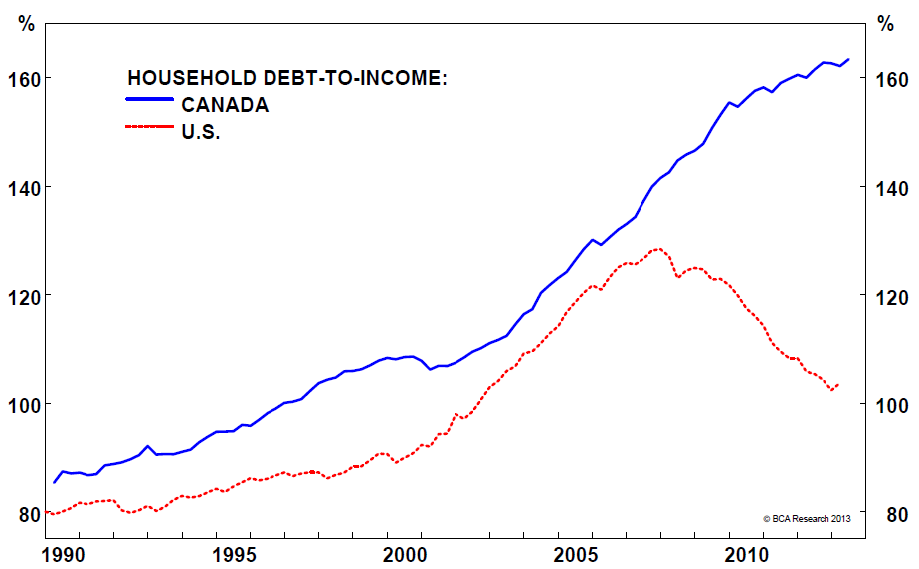
I think that Carney’s decisions introduce considerable incentive distortions in the banking system. This is clearly not what a free-market should look like. In any case, if a new crisis strikes as a result, I am pretty sure that laissez-faire will be blamed again. It is ironic to see that some of those central bankers destroy faith in free-markets while trying to protect them.
Bagehot also said other things that go against the principles driving our current banking and regulatory system. More details in another post!
Photograph: Reuters/Bloomberg
Chart: The Big Picture
Quick update on recent news: John Kay, hedge funds and house prices control
John Kay wrote an interesting piece in the FT yesterday saying that finance should be treated like fast food to secure stability. I can’t agree more. A nice quote:
Still, would it not be better if proper supervision ensured that no financial institution could ever get into a mess like Northern Rock or Lehman – or Royal Bank of Scotland or Citigroup or AIG? No, it would not. Just replace “financial institution” with “fast-food outlet” or “supermarket” or “carmaker” in that sentence to see how peculiar is the suggestion.
I know what you’re going to say: “but banks are different!” To which I would reply: no, they aren’t. It is treating them as different that makes them different.
Another nice one:
We have experience of structures in which committees in Moscow or Washington take the place of the market in determining the criteria by which a well-run organisation should be judged, and that experience is not encouraging. The truth is that in a constantly changing environment nobody really knows how organisations should best be run, and it is through trial and error that we find out.
I am a little surprised though, as I have the impression that John Kay is kind of contradicting himself (see his post from June in which he seems to say that banking reforms are going the right direction).
Another piece highlighted how much regulation is changing the hedge fund industry. What’s going on is that regulation is now limiting new entrants in the market as they can’t cope with booming compliance costs. This results in the largest hedge funds experiencing most of new money inflow from investors. Is this a problem? Yes. First, small hedge funds have traditionally outperformed large and established ones on average. So preventing them from entering the market reduces market and economic efficiency: proper allocation of capital to where it would be the most profitable does not happen as a result (and consequently, returns to investors are lower). Second, and more worrying, is that regulation is now replicating what has happened in the banking industry: it’s creating too big to fail hedge funds (and nobody seems to remember LTCM). Well done guys.
Finally for today, echoing my earlier post, a BoE member thinks that it is not the role of the central bank to control house prices. I certainly agree.
The investors’ great search for yield (and the likely collapse?)
Quite a long post… Here I’m going to have to get to the heart of my theoretical economic beliefs. I’ll try to keep it simple and as short as I can though. I will argue that there are many risks to investors going forward due to distortions in interest rates.
I wasn’t surprised yesterday when I read the two following FT articles. The first one tells how leveraged buyouts (LBOs) in the US have boomed recently, with leverage reaching the height of the pre-crisis boom of 5.3 times EBITDA, some even reaching 7.5 times EBITDA. This means that the private equity funds that acquired those firms used debt equivalent to 5 times earnings before depreciation, interest and taxes of the targets to fund the acquisitions. It is a lot. What is usually considered a highly leveraged LBO is around 4 times EBITDA and higher.
The second FT article talks about the fact that hedge funds are struggling to achieve high returns due to the size of the industry. Institutional investors have piled in hedge funds expecting higher returns than what traditional investments yield at the moment.
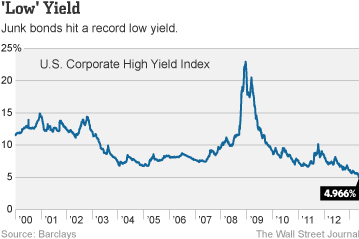
Earlier this year, we have seen many investors also piling in junk bonds, offering some of the lowest non-investment grade yields on record (despite the economy still not being in great shape and spreads over US treasuries not being at their lowest level ever). What’s going on?
Many people won’t agree with that, but to me, it looks like central banks’ monetary policies (low interest rates, quantitative easing, LTRO, OMT…) are lowering interest rates below their so-called ‘natural rates’. What is the natural rate of interest? It was the Swedish economist Knut Wicksell who came up with this term, highlighting to him the equivalent of the equilibrium free-market rate of interest in a barter world. Wicksell defined the natural rate in those terms in his 1898 book Interest and Prices, chapter 8:
“There is a certain rate of interest on loans which is neutral in respect to commodity prices, and tends neither to raise nor to lower them. This is necessarily the same as the rate of interest which would be determined by supply and demand if no use were made of money and all lending were effected in the form of real capital goods. It comes to much the same thing to describe it as the current value of the natural rate of interest on capital.” (emphasis his)

We can interpret it as the equilibrium interest rate that would exist under free market conditions, with no external interferences such as central banks’ monetary policies and governments’ interest-lowering schemes. In such conditions, intertemporal preferences between savers and borrowers are matched. This natural rate is in opposition to the ‘money rate of interest’, or the actual interest rate prevalent in a money and credit economy. The system is near equilibrium when the natural and the money rates coincide.
At the moment, some people such as Scott Sumner would argue that the natural rate of interest is below zero, justifying massive cash injection in the economy in order to lower the money rate of interest (= nominal interest rate). For him, the evidence is that nominal GDP has been allowed to fall below trend during the crisis and hasn’t recovered since then. While I agree that there was a case for an increase in the quantity of money to counteract a higher demand for money in the earlier stages of the crisis, I don’t believe this is now necessary. (I also believe that ‘trend’ is a very imperfect indicator on which to base policies. NGDP growth trend changed several times since World War 2 and can also be impacted over fairly long periods by unsustainable booms).
But it does continue. There have now been several rounds of QE in the US and monetary easing in Europe, Japan and China, to name a few. So the current situation looks like a sign that the money rate of interest has been pushed below the natural rate for quite some time. While nominal interest rates have been low for a while, real interest rates are now even lower (or even negative). And real interest rates are what investors care about, as it represents the actual gain over cost of life inflation. This has the consequence of pushing investors toward higher-yielding asset classes (hedge funds, private equity, junk bonds, emerging market equities…), in order to generate the returns they normally get on lower-risk assets.
But there is no inflation, you’re going to tell me. True, inflation as measured by CPI has also been relatively low for a while. Is CPI the right measure though? Asset prices (from real estate to equities and bonds) are not reflected in it despite arguably representing a form of inflation. Remember what Wicksell said: “There is a certain rate of interest on loans which is neutral in respect to commodity prices, and tends neither to raise nor to lower them.” Well… It’s clearly not what’s happening now. Even excluding asset classes, CPI may even not accurately reflect goods’ prices inflation. Would investors really need to search for yield if the cost of life actually declined or remained stable?
Does it mean that asset prices should always remain stable at the natural rate? Not at all, and there can be good reasons why asset prices move (real supply shocks for example). But what we can now witness in financial markets look more like malinvestments than anything else. Malinvestments represent bad allocation of capital to investments that would not be profitable under natural rate of interest conditions. As the discount rate on those investments decline in line with the nominal interest rate, they suddenly look attractive from a risk-reward point of view. But what if the discount rate is wrong in the first place? And what if future cash flows are also artificially boosted by low rates? This is a variation of the original Austrian business cycle theory, first developed by Ludwig von Mises and F.A. Hayek early 20th century, and which originally focused on the effects of a distorted interest rate on the structure of production.
Another indication – more scientific than my previous observation – that the money rate may well be below the natural rate, has been devised by a former colleague of mine. Thomas Aubrey published a very interesting book in 2012, Profiting from Monetary Policy, in which he underlines his own calculation of what he calls the ‘Wicksellian differential’ (the difference between the natural and the money rates of interest). He uses estimates of the return on capital and the cost of capital in order to calculate the differential (according to neoclassical economic theory, the real interest rate should equal the marginal product of capital in equilibrium conditions – not everybody agrees though). Using those assumptions, it does look like we have been in a new credit boom since 2010 as you can see from the charts here:
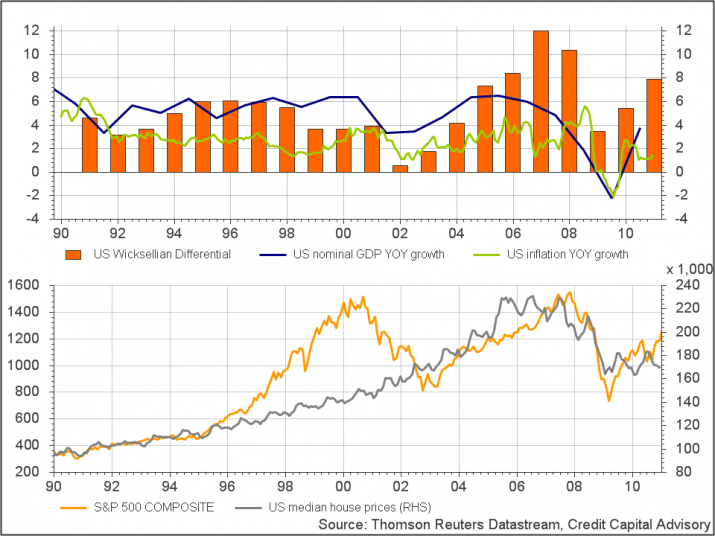
Where does this lead us? Every unsustainable boom has to end at some point. It is likely that as soon as nominal interest rates start rising above a certain level, mark to market losses and worse, outright defaults, will force investors to mark down their holdings of malinvestments. We’ve already recently seen the impact on emerging markets of a mere talk of reducing the pace of quantitative easing.
What could be the consequences? Banks don’t place their liquidity in such risky assets, but might well be exposed to clients that do (many banks provide so-called leveraged loans for instance). Such impact on banks should be relatively limited though, given current regulatory constraints and deleveraging. In turn, this should limit the damage to credit creation and reduce the risk of another monetary contraction through the money multiplier. However, and it is a big question mark, banks might be exposed to companies (and households) under life support from low interest rates. This is more likely to be the case in some countries than others (I’ll let you guess which ones). When rates rise, loan impairment charges may rise quite a lot in those countries.
Private losses (through various types of investment funds and not subject to the money multiplier) may well be large though, negatively affecting private investments for some time afterwards. If you were thinking that the economy was naturally recovering at the moment, you might give it a second thought… Investors, beware, timing will be crucial.
First chart: Wall Street Journal; Second chart: Credit Capital Advisory
Macro(un)prudential regulation
From a free-market perspective, one can only be against macroprudential regulation. Macroprudential regulation is the new fashion among regulators and other policy-makers. It’s trendy, and I understand why: it sounds clever enough to impress friends during a night out. It aims at monitoring a few macroeconomic indicators in order to try to ‘cool’ the system if it seems to be overheating. Those tools are supposed to be countercyclicals: if the economic environment is good, regulators can force the whole banking system to start accumulating extra equity or liquid assets for example, or decide to cap the amount that all banks can lend to mortgage borrowers. As you can guess, it is not the kind of self-regulating financial system I particularly appreciate.
This is once again a typical example of trying to fix the symptoms created by the system’s defects, without touching those defects. Wrong monetary policy? Bad government policies and subsidies? Of course not, the financial system is inherently bad and fragile, regulators and politicians said. Well, to be fair, this is their job and how they make money.
Lars Christensen, chief analyst at Danske Bank and author of The Market Monetarist blog, had a couple of niece pieces against macroprudential regulation recently. In the first one, he quotes and agrees with a recent WSJ article by John Cochrane, financial economist at the University of Chicago (also available on his blog):
This is Cochrane:
Interest rates make the headlines, but the Federal Reserve’s most important role is going to be the gargantuan systemic financial regulator. The really big question is whether and how the Fed will pursue a “macroprudential” policy. This is the emerging notion that central banks should intensively monitor the whole financial system and actively intervene in a broad range of markets toward a wide range of goals including financial and economic stability.
For example, the Fed is urged to spot developing “bubbles,” “speculative excesses” and “overheated” markets, and then stop them—as Fed Governor Sarah Bloom Raskin explained in a speech last month, by “restraining financial institutions from excessively extending credit.” How? “Some of the significant regulatory tools for addressing asset bubbles—both those in widespread use and those on the frontier of regulatory thought—are capital regulation, liquidity regulation, regulation of margins and haircuts in securities funding transactions, and restrictions on credit underwriting.”
This is not traditional regulation—stable, predictable rules that financial institutions live by to reduce the chance and severity of financial crises. It is active, discretionary micromanagement of the whole financial system. A firm’s managers may follow all the rules but still be told how to conduct their business, whenever the Fed thinks the firm’s customers are contributing to booms or busts the Fed disapproves of.
I completely agree with Cochrane.
And I completely agree with both of them. Christensen argues that the central bank’s goal is to provide nominal stability – to have a single target and stick to it, but that macroprudential regulation would involve manipulating many different tools having opposite effects, with likely unintended consequences. He then goes on to argue that if “markets are often wrong”, central banks are even worse and “have a lousy track record” at spotting bubbles.
Another important point made by Cochrane in my opinion is:
Third lesson: Limited power is the price of political independence. Once the Fed manipulates prices and credit flows throughout the financial system, it will be whipsawed by interest groups and their representatives.
= crony capitalism. This has plagued all corners of our capitalist system for ages, and when things turn bad, free markets/laissez-faire capitalism/liberalism/neoliberalism/ultra turboliberalism/add the one you want is blamed… Go figure.
Christensen’s second post, published a few days ago, refers to a Bloomberg article on the so-called ability of a new Finnish model to ‘forecast’ all cyclical up and downswings in the US over the past 140 years… He helpfully remembers that nobody is ever able to constantly beat the market. While this sounds like a rational expectations/efficient market hypothesis point of view (I don’t know what Lars actually believes in), I do agree with him (and no I don’t believe in rational expectations, but constantly beating the market requires non-human skills and information-gathering abilities). He then goes on to say that while this is relatively basic economics, “nowadays central bankers increasingly think they can beat the markets. This is at the core of macroprudential thinking.”
Obviously, the whole thing rests on the myth that the financial system is fragile and must be ‘safeguarded’ or ‘protected’ (see this IMF article) by ‘benevolent dictators’, in Christensen’s words. I would also add that macroprudential ideas are now new and have been already tried one way or another since the early 19th century (but how many regulators and economists remember that? See an example here).
This is how I see things: no central body can ever have perfect knowledge of what’s happening in the economy and what the various plans, wishes and wants of the millions of actors in the system are (I am obviously not the first one to say this. See Mises, Hayek, Friedman and so many others). As a result, any central intervention is bound to fail or create distortions in the economic landscape.
Central banks are a monopoly: they define nominal interest rates and base money supply unilaterally and can only adjust their policies with a time lag, after they have already affected the economy. A distorting monetary policy can easily kickstart asset bubbles: an increasing supply of ‘high-powered’ money (base money) not matched by an increase in the demand for money can easily lead to excess credit creation. If real estate prices boom due to the flow of credit towards the sector, is it reasonable to try to stop it? The flow of credit is already here, and if it cannot go where it wanted in the first place, it will find another place to go to. China and its wealth management products is a good example of this process.
Let’s consider a current example in the UK. Due to a combination of interest rates maintained too low for too long, misguided government schemes such as Funding for Lending and Help to Buy, compounded by Basel regulations that favour mortgage lending and local restrictions on housing supply, if ever a housing bubble appears, the solution will be to… blame the banks and artificially restrict LTVs or cap lending??? Right…
Finance is a spontaneous process: people can be very innovative at finding ways of bypassing restrictions to achieve their desired financing and saving goals. Macroprudential controls would only move the problem from one sector to another, without correcting its very source. Macroprudential regulation would also introduce an unwelcome dose of discretionary rules and micromanagement, which have destabilising effects on trust, markets and economic actors.
Photograph: Wikipedia
 Spontaneous Finance
Recent Comments