News digest (Libor 1.7bn fine, banks’ poor IT systems, banking, telco, IT, retailing convergence…)
Again this week, so many things happening that I can’t spend much time commenting on each and I have to make choices!
George Osborne, UK’s Chancellor of the Exchequer, is about to announce a tax-free treatment for P2P lending, which could be included in individual Isa accounts. This is a good thing. Nothing much more to say…
The Bank of England is thinking of asking UK-based banks to provide regulatory capital ratios calculated using standard risk-weights as defined by Basel’s Standardised method. These ratios would not replace those banks’ main capital ratios as currently calculated (under the IRB method) but would ‘complement’ them. It’s a good idea and we may well end up having a few surprises…
The EU has fined some of the large global banks as part of the Libor rate-rigging. Banks will have to pay EUR1.7bn. This isn’t that significant given what JPMorgan has paid so far in fines in the US… I stopped counting and I may well be wrong but I think they paid around USD$15bn so far this year. Surely this should make me doubt about the ability of laissez-faire to regulate banks? Not really. First, we are not in a laissez-faire environment. Second, laissez-faire does not mean laissez-faire fraudulent activities. It means laissez-faire people to negotiate their own contracts and agreements. When those contracts are not respected, when there is fraud, punishment should ensue. Laissez-faire is completely in favour of the rule of law. Moreover in a real free-market environment, it is likely that most fraudulent banks would already be out of business…
Something I know from experience: many banks have really poor IT systems and poorly-designed databases. This week, Royal Bank of Scotland’s customers could not access their accounts anymore for a whole day (and pretty busy shopping day on top of that). Its CEO acknowledged that the bank will have to invest… GBP1bn in its IT systems. That’s a massive bill. It shows how outdated its IT systems must have been. It is scary to see that some banks (nop, no name), whether small, medium-sized or massively massive have such poorly-designed systems that they cannot adequately track simple data such as their exposures and the level of provisioning against them by industrial sector or geographical area for example. This is the result of years, if not decades, of underinvestment in IT. This is also why start-up banks are usually much more efficient: they have top-notch IT. For large banks, no surprise, trading systems have been upgraded at a much faster pace than commercial and retail banking ones. Banks are currently plagued by their high cost base. But more efficient IT systems would have helped maintain their costs lower while improving internal productivity.
Moreover, banks are also under threat from new financial actors, and possibly future data-heavy entrants such as Google and Amazon. Those firms have great IT systems: it is their core business. What if they entered the banking business? It’s what Spain’s BBVA’s CEO asked in the FT this week. Indeed, banks are now closing branches one by one as customers move online or mobile. It also means that new entrants possibly wouldn’t need any branch network altogether and could offer more efficient services to customers, using their huge data centres and cloud computing capabilities. A quick visit to the annual Barcamp Bank ‘unconference’ shows how many people are currently working on new customer-friendly and efficient banking API and other systems. We’ve already seen the ‘convergence’ of IT, telecoms and media. Are we about to witness a banking, IT, telecom, retailing, online search and payment convergence?
Are synthetic CDOs making a comeback? Well, issuance volume is still pretty low… Unless low interest rates start over-boosting this market too?
Finally, Columbia University’s Charles Calomiris has his own take on Admati and Hellwig’s recommendations and rejects some of their claims (such as the fact that higher equity levels would not impair lending, a claim that I have already made here, although my reasoning was different). He also favours rising banks’ equity requirements though.
Statism and the ideological war against Bitcoin
While the US Senate provided some support to Bitcoin and other digital alternative ‘currencies’, most of central banks and regulatory authorities around the world seem to have declared war against them. Yesterday, Alan Greenspan, the former Fed Chairman, said that Bitcoin was a bubble and that it had no intrinsic value. Although his track record at spotting bubbles is rather… poor.

China’s central bank, the PBoC, banned financial institutions from doing any kind of business with it. Is it surprising from a country in which citizens are subject to financial repression and capital controls and who as a result see Bitcoin as a step towards financial freedom? It was very unlikely that China would endorse a medium of exchange over which it has no control. This is also true of other central banks. Today, Business Insider reported that the former Dutch central bank president declared that Bitcoin was worse than the 17th century Tulip mania. FT Alphaville continued its recurrent attacks against Bitcoin. The Banque de France also published a very bearish note on the now famous digital currency. The title couldn’t be more explicit: “The dangers related to virtual currencies’ development: the Bitcoin example”. What’s striking with the Banque de France note is that it pretty much sums up all criticisms (misplaced or not) against the virtual currency.
They start with the fact that Bitcoin is “not regulated.” Horror. Well, not only it is the goal guys, but it‘s not even completely true: Bitcoin’s issuance is actually very tightly regulated by its own algorithm, which replaces the discretionary powers of central banks. They add that Bitcoin provides “no guarantee of being paid back” and that its value is volatile. Yes, this is what happens when we invest in any sort of asset. To them, Bitcoin’s limited growth and resulting scarcity was intentionally introduced by its designer to provide it with a speculative nature. Not really… The design was a response to central banks’ lax use of their currency-issuing power. Moreover, Bitcoin’s value is the “exclusive result of supply and demand”! I guess that, for central bankers, this is indeed shocking. For classical liberals like me, or libertarians, this is the way it should be.
I think the ‘best’ argument against Bitcoin is the fact that, as it is anonymous, it can be used in criminal and fraudulent activities and money laundering. Wait… isn’t central bank cash even more anonymous? Hasn’t central bank cash been used in fraudulent activities and money laundering for decades, if not centuries? Are central banks involved in Know Your Customer practices? Finally, another argument of the Bank de France is: there is no authority safeguarding the virtual wallets, exposing them to hackers and other potential threats. True, there is no example in history of ‘authorities’ stealing, debasing or manipulating the reserves of media of exchange they were supposed to ‘safeguard’…* The central bank harshly concludes that Bitcoin’s use “presents no interest to economic agents beyond marketing and advertising, while exposing them to large risks.”
As I have said several times, Bitcoin is surely not perfect. But neither are our current official fiat currencies. I am neither for nor against Bitcoin or any digital currency. I am in favour of letting the markets experiment and pick the currency they judge appropriate. I am against a central authority forcing the use of a certain currency.
Let’s debunk a few other myths.
First, Bitcoin is not money. It is at best a commodity-like asset, such as gold, or a very limited medium of exchange. But it is not a generally accepted medium of exchange, the traditional definition of money. Perhaps someday. But not at the moment. Current institutional frameworks also make it very difficult for it to become generally accepted: legal tender laws, taxation in official currencies, and central banks’ monopoly on the issuance of money severely slow down the process.
As a result, the complaints that we keep hearing that its value is volatile and doesn’t allow for stable prices and economic efficiency through menu costs is completely misplaced. For a simple reason: apart from a few exceptions, there is no price denominated in Bitcoin! When you want to buy a good using Bitcoin, Dollar or Euro (or whatever) prices are converted into Bitcoins. Because Bitcoin has its own FX rate against those various currencies, when its value against another currency fluctuates, the purchasing power of Bitcoin in this currency fluctuates and prices converted into Bitcoins fluctuate! Prices originally denominated in Bitcoin would not fluctuate however.
What happens when you are an American tourist visiting Europe? Your purchasing power is in USD. But you have to buy goods denominated in EUR. As a result, your purchasing power fluctuates every day as you use USD to buy EUR goods. It is the same with Bitcoin. For now Bitcoin effectively involves FX risk. Either the consumer bears the risk of seeing its purchasing power fluctuates, or the seller/producer bears it, knowing that his own input prices were not in Bitcoin. At the moment, in the majority of cases, consumers/buyers bear the risk. Perhaps a bank could step in and start proposing Bitcoin FX derivatives for hedging purposes to its clients? Actually, a Bitcoin trading platform actually already offers an equivalent service.
Something that is really starting to annoy me every time I hear it is that Bitcoin is not like traditional fiat money, as it is not backed by anything and thus has no intrinsic value. Sorry? The very definition of fiat money is that it is not backed by anything! And none of the efforts of some Modern Monetary theorists, chartalists, or FT Alphaville bloggers will manage to convince us of the contrary. They claim that fiat money has intrinsic value as it is backed by “the government’s ability to tax the community which bestows power on it in the first place. This tax base represents the productive capacity of the collective wealth assets of the US community, its land and its resources. The dollar in that sense is backed by the very real wealth and output of the system. It is not just magic paper”, as described by the FT Alphaville blog post mentioned above. Right. This all sounds nice and abstract but can I show up at my local central bank and redeem my note for my share of “the productive capacity of the country”?**
A fiat money isn’t backed by anything at all but by faith. The only thing that gives fiat money its value is economic agents’ trust in it. When this trust disappears the currency collapses. It happened numerous times in history but I guess it is always convenient for some people to forget about those cases. A recent example was the hyperinflation in Zimbabwe: despite legal tenders laws and the fact that taxes were collected in Zimbabwean Dollars, the population lost faith in the currency and turned towards alternatives, mainly USD, EUR and South African Rand. People could well lose faith in advanced economies’ official currencies and start trusting Bitcoin (or any other medium of exchange) more. At that point, Bitcoin would still be fiat but become effectively ‘backed’ by the faith of economic agents and could well trigger a switch in the money we use on a day to day basis.
Another (half) myth is that Bitcoin is only a tool for speculation that diverts real money from real ‘productive purposes’. It is true that, as an asset, Bitcoin will always attract speculators. But it doesn’t necessarily divert money from the real economy: 1. when Bitcoins are sold, they are swapped for real money, money that does not remain idle but then can be used for ‘productive purposes’ by the new holder (or his bank) and 2. as a medium of exchange, Bitcoin can actually facilitate trade and hence ‘productive activities’. Don’t get me wrong: this does not mean that there are no better investment opportunities than Bitcoin. Investors will decide, and if the digital currency is destined to fail, it will, and the markets will learn.
There are other problems with Bitcoin, one of which being that it provides an inelastic currency as its supply is basically fixed. However, in a Bitcoin-standard world (as opposed to a gold-standard), we could probably see the emergence of fractional reserve banks that would lend Bitcoin substitutes and issue various liabilities (notes and deposits mainly) denominated in Bitcoin and redeemable in actual Bitcoin (which would then play the role of high-powered money). This mechanism would then provide some elasticity to the currency (and therefore to the money supply) to respond to increases and decreases in the demand for money.
Bitcoin seems to enrage central bankers, regulators, Keynesians (particularly post-Keynesians), chartalists, Modern Monetary theorists and other statists. Consequently they resort to myths and misconceptions in order to threaten its credibility. As I have already said, my stance is neutral. Alternative currencies will come and go. Some will fail. Others will succeed. Markets will decide. I argue that alternative currencies contribute to the greater good as they all of a sudden introduce monetary competition between emerging private actors and traditional centralised institutions. If alternative currencies can eventually force central banks and states to better manage their own currencies, it would be for the benefit of everyone.
To end this piece, let me quote Hayek:
But why should we not let people choose freely what money they want to use? By ‘people’ I mean the individuals who ought to have the right whether they want to buy or sell for francs, pounds, dollars, D-marks or ounces of gold. I have no objection to governments issuing money, but I believe their claim to a monopoly, or their power to limit the kinds of money in which contracts may be concluded within their territory, or to determine the rates at which monies can be exchanged, to be wholly harmful.
Well said mate.
* This was irony, for those who didn’t get it.
** The spontaneous development of alternative local currencies (such as this one) by individuals lacking balances in the official currency of the country but willing to trade goods or to propose services, is another example of a non-state issued money (and not collected to pay taxes) that facilitate economic output and the generation of wealth, in direct contradiction to the state theory exposed above.
Chart: CNN
Banks’ RWAs as a source of malinvestments – Some recent empirical evidence
A recent study by academics from the Southern Methodist University and the Wharton School of the University of Pennsylvania had very interesting findings (the actual full paper can be found here): banks based near booming housing markets charged higher interest rates and reduced loan amounts to companies, which ended up investing less than companies borrowing from banks located in stable (or falling) housing markets. They called this the “crowding-out effect of house-price appreciation”. The study gathered data from 1988 to 2006 in the US, during the Basel period. It would have been interesting to compare with the pre-Basel era and replicate it with European markets.
Conventional economic knowledge seemed to think that “to the extent that home prices begin to rise, consumers will feel wealthier; they’ll feel more disposed to spend…that’s going to provide the demand that firms need in order to be willing to hire and to invest.” (This is Ben Bernanke as quoted by The Economist, which mentioned this study a few weeks ago)
But our academics instead found an inverse relationship:
We estimate that a one standard-deviation increase in housing prices (about $79,700 in year 2000 dollars) that a bank is exposed to decreases investment by firms related to that bank by almost 6.3 percentage points, which is approximately 12% of a standard deviation for firm investment. Banks also increase the interest rate charged by 9 basis points, reduce outstanding loans by approximately 9%, and reduce loan size by approximately 4.5%. These results are consistent with banks reducing the supply of capital to firms in response to increased housing prices.
So much for the Keynesianism of housing bubbles…
Their findings was summarised in an easier to read single chart by The Economist:

I think they are spot on in identifying this crowding out effect but overlook the underlying importance of Basel’s risk-weighted assets in triggering the boom and forcing the reallocation of capital towards housing. In their paper, there is not a single reference to Basel, banks’ capital requirements (apart from one related to MBS) and RWAs. But their story matches almost perfectly the RWA-based ABCT model I described in my previous post on the topic.
What did my model say? That the supply of loanable funds would be reduced to businesses and increased to real estate as a result of capital-optimising choices made by banks (because of RWAs capital constraints). That consequently, interest rates would increase for businesses and be reduced for real estate. This is exactly what they found.
But it doesn’t stop here. The model also said that an increase in interest rates to businesses would shorten their structure of production as interest-sensitive long-term investments become unprofitable. What did they find? That businesses reduced investments despite the temporary boost in consumption due to the well-referenced wealth effects (which they also mentioned)…
However, they missed the deeper implications of banking regulation on the reallocation of capital from businesses to real estate. To them, house price increases seems to be the only factor diverting capital towards housing. I don’t deny that increasing house prices would bring about self-reinforcing house lending, even in a free market: as house prices increase, lending gets facilitated and speculators are attracted, pushing prices up even further. But my point is that regulation and RWAs can both trigger and exacerbate the process way beyond the self-correcting point at which it would normally stop (and collapse) in a free market environment.
There is catch though… If RWAs do indeed trigger a boom in house lending, how could they find some areas in the US within which the process actually wasn’t triggered (no increase in house prices/lending) despite being subject to the same regulatory framework? Well, there are possibly a few answers to that question. Some local banks could actually be in an area experiencing falling house prices for some reason (even though they increase nationally) and low mortgage demand. This would automatically limit the amount they lend and push RWAs on real estate up, making housing less attractive from a capital-optimisation point of view. Another possibility would be that those local banks are actually subsidiaries of other banks that try to optimise capital usage on an aggregate (national) basis. However, it is hard to say as the criteria used to build the sample of banks are not clear.
There is another, simpler, possible explanation: even in falling housing prices areas, local banks’ business lending was still constrained and mortgage lending still supported! Meaning that, in a RWA-free world (and excluding a recessionary environment), a decline in housing prices would have triggered an even sharper decrease/increase in mortgage/business lending. This cannot be proved with this study however. There could also be other explanations that haven’t come to my mind yet.
Overall, I remain slightly sceptical of statistical/regression/correlation-based economic studies and I’ll take this one with a pinch of salt, especially as they use various assumptions and proxies that could easily distort the outcome. Nonetheless, the results they obtained were quite significant. And they provide some empirical evidences to my very theoretical model.
Meanwhile, Nouriel Roubini on Friday, in a piece called Back to Housing Bubbles, listed all the markets in which there are signs of bubbles:
[…] signs of frothiness, if not outright bubbles, are reappearing in housing markets in Switzerland, Sweden, Norway, Finland, France, Germany, Canada, Australia, New Zealand, and, back for an encore, the UK (well, London). In emerging markets, bubbles are appearing in Hong Kong, Singapore, China, and Israel, and in major urban centers in Turkey, India, Indonesia, and Brazil.
Real estate bubbles existed before Basel introduced risk-weighted assets, but nothing on that scale and in so many countries at the same time. Time for policy-makers to wake up.
RWA-based ABCT Series:
- Banks’ risk-weighted assets as a source of malinvestments, booms and busts
- Banks’ RWAs as a source of malinvestments – Update
- Banks’ RWAs as a source of malinvestments – A graphical experiment
- Banks’ RWAs as a source of malinvestments – Some recent empirical evidence
- A new regulatory-driven housing bubble?
Cato Institute’s 31st Monetary Conference – Was the Fed a good idea?
About two weeks ago, the US-based think tank Cato organised its annual monetary conference. Great panels and very interesting speeches.

Three panels were of particular interest to me: panel 1 (“100 Years of the Fed: What Have We Learned?”), panel 2 (“Alternatives to Discretionary Government Fiat Money”), panel 3 (“The Fed vs. the Market as Bank Regulator”).
In panel 1, George Selgin destroys the Federal Reserve’s distorted monetary history. Nothing much new in what he says for those who know him but it just never gets boring anyway. He covers: some of the lies that the Federal Reserve tells the general public to justify its existence, pre-WW2 Canada and its better performing monetary system despite not having a central bank, the lack of real Fed independence from political influence and……the Fed not respecting Bagehot’s principles despite claiming to do so. In this panel, the speech of Jerry Jordan, former President of the Federal Reserve Bank of Cleveland, is also very interesting.
In panel 2, Larry White speaks about alternatives to government fiat money, counterfeiting laws and state laws making it illegal to issue private money. Scott Sumner describes NGDP level targeting. Here again, nothing really new for those who follow his blog, but interesting nonetheless (even though I don’t agree with everything) and a must see for those who don’t.
In panel 3, John Allison provides an insider view of regulators’ intervention in banking (he used to be CEO of BB&T, an American bank). He argues that mathematical risk management models provide unhelpful information to bankers. He would completely deregulate banking but increase capital requirements, which is an original position to say the least. Kevin Dowd’s speech is also interesting: he covers regulatory and accounting arbitrage (SPEs, rehypothecation…) and various banking regulations including Basel’s.
Overall, great stuff and you should watch the whole of it (I know, it’s long… you can probably skip most Q&As).
PS: Scott Sumner also commented on the Pope’s speech on “evil incarnate”. Reminds me of the vocabulary I used…
News digest (Krugman and deregulation, central banking for Bitcoin…)
A looooooooot of news since the beginning of the week. So I’ll just quickly go over a few of them. Guys please, next time, spread your news more evenly over time. There was nothing to comment on recently!
Not new news but the Swedish bank regulators are thinking of increasing RWAs on mortgages to fight a growing housing bubble. Well, raising them to 25% (from 15% floor…) would still not change much: they would remain below most other asset classes’ level and securitisation (RMBS) would allow banks to bypass the restrictions.
Meanwhile, Yves Mersch, member of the Executive Board of the ECB, spoke about how to revive SME lending in bank-reliant Europe. His solutions involve: strengthening banks, securitisation and… banking union. Any word of capital requirements/risk-weighted assets? Not a single one. When I told you that central bankers don’t seem to get it…
But the UK government wants to ditch the household lending side of the Funding for Lending Scheme! They now only want to provide cheap funding to banks if they prove that they lend to SMEs. Why not, but I doubt it would really work for a few reasons: 1. demand for loans remains quite low, 2. market funding remains cheap (it was cheaper than FLS), 3. banks haven’t drawn much on it anyway, 4. RWAs are still in place! Mortgage and household lending will still attract most of lending volume as it is more profitable from a capital point of view.
Meanwhile (again), SME financing from alternative lenders not subject to RWAs and other stupid capital rules, keeps growing in the UK. However, it is still tough for those lenders to assess the health of the companies that would like to lend to.
Erkki Liikanen, the Governor of the central bank of Finland, told us about his ideas to improve financial stability. Surprise: they haven’t changed. So macroprudential policy starts interfering with macroeconomic policies and financial regulation, with possibly opposite effects that don’t seem to bother him much. Look at that slide, which is the very definition of a messy policy goal, with multiple targets and interferences:
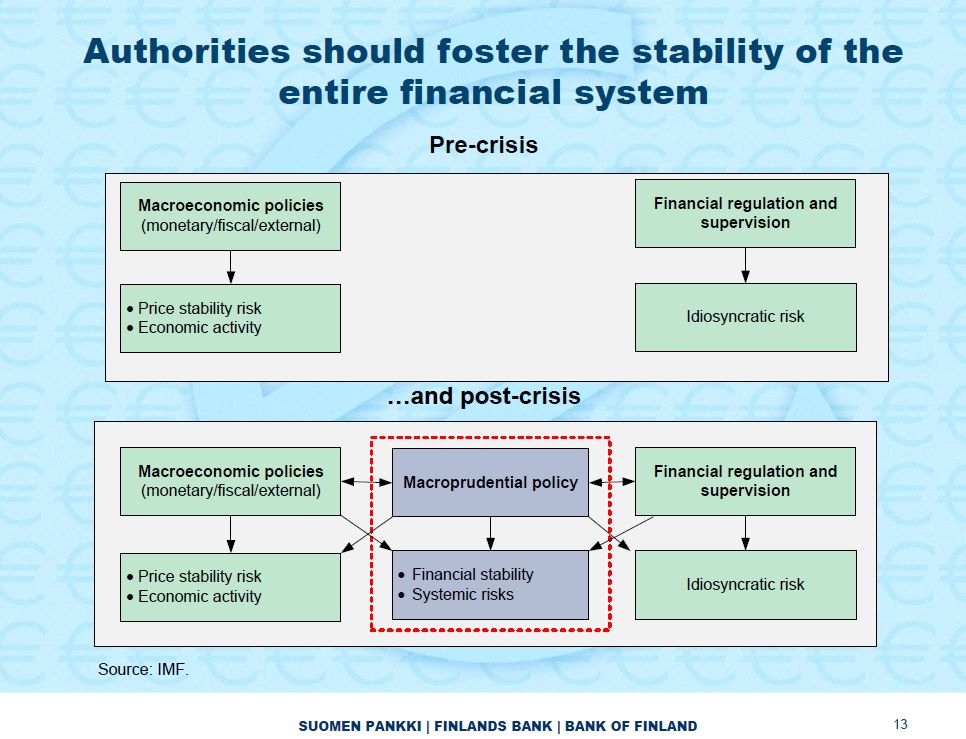
A very strange piece in the Washington Post: Bitcoin needs a central banker. Wait a second. No, it’s definitely not the 1st of April. First, the author asserts that Bitcoin’s wild changes in value make it difficult to be adopted as a currency. This is extraordinary. Does the author even understand FX rates? If the author wishes to purchase his coffee using Euros, despite the coffee being priced in Dollars, will he also declare that the fact the Euro’s value is unstable (making the effective Euro price of its coffee volatile) makes the currency improper for use? When prices are originally denominated in Bitcoin, the change in the value of the digital currency won’t affect them. When prices are actually denominated in USD, but converted into Bitcoin, then yes, changes in the value of the digital currency will affect them. But this is hardly Bitcoin’s fault… Then he gets mixed up with ‘menu costs’, ‘hyperinflation’, ‘money demand’, etc. Wow. Just one last thing: has he even understood that Bitcoin was designed to be free from central bankers and government intervention in the first place?
Izabella Kaminska in the FT wrote a new piece on Bitcoin and other alternative electronic currencies. She complains about the multiplication of such currencies that nothing backs and pretty much only see speculative motivations underlying them. I am not going to comment on the whole thing, but whether right or wrong, she should ask herself why there is such frenzy about those currencies at the moment. My guess is that, governments’ and central banks’ manipulation of their own currencies have unleashed a beast: people afraid to hold classic currencies started to look for alternatives, pushing up their prices, in turn attracting speculators. The process is similar to ‘bad’ financial innovations (the ones designed specifically to bypass restricting regulation): they often start as a benign innovation for the ‘common good’, but the surprising demand for them and large profits attract speculators until the market crashes. Not the fault of the innovation, but the fault of the regulation that triggered them…
Paul Krugman thinks that “the trouble with economics is economists”, and that mainstream economics is not to blame for the financial crisis. I partly disagree: 1. there are various schools of thought within mainstream economics that often disagree with each other altogether and 2. most (all?) of them cannot fully explain the crisis anyway. But, and this is where Krugman shows his limited knowledge of banking and therefore the limit of his reasoning, he declares that “the mania for financial deregulation, for example, didn’t come out of standard economic analysis.” I’m sorry? Which mania for financial deregulation? The international banking sector had never been as regulated in history as on the eve of the crisis! (even taking into account of the few one-off deregulations) I need to come back to this in a subsequent post. Really, Paul, you have to revise your history. And your reasoning.
On Free Banking, George Selgin urges Scots to ‘poundize’ unilaterally if ever they declare independence from the UK. And “if the British Parliament refuses to cooperate, so much the better. Who knows: Scotland could even end up with a banking system as good as the one it had before 1845, when Parliament, which knew almost as little about currency then as it does now, began to bugger it up.” If only Scotland could enlighten the world a second time and get back to a free banking system!
The Pope fights against the dark side of the For…invisible hand (irony inside)

The Pope came up with his latest ‘Apostolic Exhortation’ which rightly criticises those very evil free-markets. A few quotes:
The current financial crisis can make us overlook the fact that it originated in a profound human crisis: the denial of the primacy of the human person!
Really? I thought it originated in an unfortunate combination of too low interest rates and ill-defined regulation. I must have got it plain wrong.
While the earnings of a minority are growing exponentially, so too is the gap separating the majority from the prosperity enjoyed by those happy few. This imbalance is the result of ideologies which defend the absolute autonomy of the marketplace and financial speculation. Consequently, they reject the right of states, charged with vigilance for the common good, to exercise any form of control. A new tyranny is thus born, invisible and often virtual, which unilaterally and relentlessly imposes its own laws and rules.
States and politicians have always sought power for the common good, that’s for sure. I thought the Vatican was in Rome, where Berlusconi, a truly disinterested politician who sacrificed himself for the common good, ruled for many years. News reports don’t seem to be reliable around there. The Pope is right: for the greater good, we should all be governed and controlled by a handful of individuals whose only wish is to improve our way of life (rather than by a multitude of selfish individuals who have opposite interests and very limited control on anything).
Debt and the accumulation of interest also make it difficult for countries to realize the potential of their own economies and keep citizens from enjoying their real purchasing power. To all this we can add widespread corruption and self-serving tax evasion, which have taken on worldwide dimensions.
The Pope is right again: all those highly indebted countries have become so because of free markets’ greed. Certainly not because of the disinterested politicians who rule them. But, wait… Corrupted politicians? What do you mean? I thought they were “charged with vigilance for the common good”!
We can no longer trust in the unseen forces and the invisible hand of the market.
True. We have lived in free-markets for too long. We now have to rein them in and replace the invisible hand with Berlusconi’s hand.
Right. So I guess I, and my blog, are unlikely going to end in Heaven. I should have thought about that before opening it 
Actually, I’m pretty sure that God’s knowledge is beyond comparison with our current Pope’s. I can sleep well tonight.
Let’s finish with Frederic Bastiat (The Law):
If the natural tendencies of mankind are so bad that it is not safe to permit people to be free, how is it that the tendencies of these organizers are always good? Do not the legislators and their appointed agents also belong to the human race? Or do they believe that they themselves are made of a finer clay than the rest of mankind?
Banks’ RWAs as a source of malinvestments – A graphical experiment
Today is going to be experimental and theoretical. I have already outlined the principles behind the RWA-based variation of the Austrian Business Cycle Theory (ABCT), which was followed by a quick clarification. I am now attempting to come up with a graphical representation to illustrate its mechanism. In order to do that, I am going to use Roger Garrison’s capital structure-based macroeconomics representations used in his book Time and Money: The Macroeconomics of Capital Structure. I am not saying that what I am about to describe is 100% right. Remember that this remains an experiment that I just wrote down over those last few days and that needs a lot more development. There may well also be other ways of depicting the impacts that Basel regulation’s RWAs have on the capital structure and malinvestments. Completely different analytical frameworks might also do. Comments and suggestions are welcome.
This is what Garrison’s representation of the macroeconomics of capital structure looks like:

It is composed of three elements:
- Bottom right: this is the traditional market for loanable funds, where the supply and demand for loanable funds cross at the natural rate of interest. It represents economic agents’ intertemporal preferences: the higher they value future goods over present goods, the more they save and the lower the interest rate. The x-axis represents the quantity of savings supplied (and investments) and the y-axis represents the interest rate.
- Top right: this is the production-possibility frontier (PPF). In Garrison’s chart, it represents the sustainable trade-off between consumption and gross investment. Only movements along the frontier are sustainable and supposed to reflect economic agents’ preferences. Positive net investments and technological shocks expand the frontier as the economy becomes more productive.
- Top left: this is the Hayekian triangle. It represents the various stages of production (each adding to output) within an industry. See details below:
 I don’t have time to come back to the original ABCT and those willing to find out more about it can find plenty of examples online. Today I wish only to try to understand the impact of regulatory-defined risk-weighted assets on this structure. Ironically, it becomes necessary to disaggregate the Austrian capital-based framework to understand the mechanics and distortions leading to a likely banking crisis. In everything that follows, and unlike in the original Austrian theory, we exclude central banks from the picture (i.e. no monetary injection). We instead focus only on monetary redistribution. The story outlined below does not explain the financial crisis by itself. Rather, it outlines a regulatory mechanism that exacerbated the crisis.
Let’s take a simple example that I have already used earlier. Only two types of lending exist: SME lending and mortgage/real estate lending. Basel regulations force banks to use more capital when lending to SME and as a result, bankers are incentivised to maximise ROE through artificially increasing mortgage lending and artificially restricting SME lending, as described in my first post on the topic.
In equilibrium and in a completely free-market world with no positive net investment, the economy looks like Garrison’s chart above. However, bankers don’t charge the Wicksellian natural rate of interest to all customers: they add a risk premium to the natural rate (effectively a ‘risk-free’ rate) to reflect the risk inherent to each asset class and customer. Those various rates of interest do reflect an equilibrium (‘natural’) state, which factors in the free markets’ perception of risk. Because lending to SME is riskier than mortgage lending, we end up with:
natural (risk free) rate < mortgage rate (natural rate + mortgage risk premium) < SME rate (natural rate + SME risk premium)
What RWAs do is to impose a certain perception of risk for accounting purposes, distorting the normal channelling of loanable funds and therefore each asset class’ respective ‘natural’ rate of interest. Unfortunately, depicting all demand and supply curves, their respective interest rates and the changes when Basel-defined RWAs are applied would be extremely messy in a single chart. We’re going to illustrate each asset class separately with their respective demand and supply curve. Let’s start with mortgage (real estate) lending:
 Given the incentives they have to channel lending towards capital-optimising asset classes, bankers artificially increase the supply of loanable funds to all real estate activities, pushing the rate of interest below the natural rate of the sector. As the actual total supply of loanable funds does not change, returns on savings remain the same. In our PPF, this pushes resources towards real estate. Any other industry would interpret the lowered rate of interest as a shift in people’s intertemporal preferences towards the future and increase long-term investments at the expense of short-term production. Indeed, long-term housing projects are started. This is represented by the thin dotted red triangle.
However, the short-term housing supply is inelastic and cannot be reduced. The resulting real estate structure of production is the plain red triangle. Nonetheless, real estate developers have been tricked by the reduced interest rate and the long-term housing projects they started do not match economic agents’ future demand. Meanwhile, savers, adequately rewarded for their savings, do not draw down on them (or don’t have to), but are instead incentivised to leverage as they (indirectly) see profit opportunities from the differential between the natural and the artificially reduced rate. Leverage effectively becomes a function of the interest rate differential:

The increased leverage boosts the demand for existing real estate, bidding up prices, starting a self-reinforcing trend based on expected further price increases. We end up in a temporary situation of both short-term ‘overconsumption’ of real estate and its associated goods, and long-term overinvestments (malinvestments). This situation is depicted by the thick dotted red triangle and represents an unsustainable state beyond the PPF.

On the other hand, bankers artificially restrict the supply of loanable funds to SME, pushing the rate of interest above the natural rate. Tricked by a higher rate of interest, SMEs are led to believe that consumers now value more highly present goods over future goods (as they ‘apparently’ now save less of their income). They temporarily reduce interest rate-sensitive long-term investments to increase the production of late stages consumer goods. This results in an overproduction of consumer goods relative to economic agents’ underlying present demand. Nonetheless, wealth effects from the real estate boom temporarily boost consumption, maintaining prices level. Overconsumption of present goods could also eventually appear if and when savers start leveraging their consumption through low-rate mortgages, as house prices seem to keep increasing. In the long-run, SMEs’ investments aren’t sufficient to satisfy economic agents’ future demand of consumer goods.
With leverage increasing and the economy producing beyond its PPF, the situation is unsustainable. As increasingly more people pile in real estate, demand for real estate loanable funds increases, pushing up the interest rate of the sector. Interest payments – which had taken an increasingly large share of disposable income in line with growing leverage – rise, putting pressure on households’ finances. The economy reaches a Minsky moment and real estate prices start coming down. Real estate developers, who had launched long-term housing projects tricked by the low rates, find out that these are malinvestments that either cannot find buyers or are lacking the financial resources to be completed. Bankruptcies increase among over-leveraged households and companies. Banks start experiencing losses, contract lending and money supply as a result, whereas savers’ demand for money increases. The economy is in monetary disequilibrium. Welcome to the financial crisis designed in the Swiss city of Basel.
This all remains very theoretical and I’ll try to dig up some empirical evidences in another post. Nonetheless, the story seems to match relatively well what happened in some countries during the crisis. Soon after Basel regulations were implemented, household leverage in Spain or Ireland took off and came along with increasing house prices and retail sales, which both collapsed once the crisis struck. Under this framework, the artificially restricted supply of loanable funds to SME and the consequent reduction in long-term investments could also partly explain the rich world manufacturing problems. However, I presented a very simple template. As I mentioned in a previous post, securitisation and other banking regulations (liquidity…) blur the whole picture, and central banks can remain the primary channel through which interest rates are distorted.
RWA-based ABCT Series:
- Banks’ risk-weighted assets as a source of malinvestments, booms and busts
- Banks’ RWAs as a source of malinvestments – Update
- Banks’ RWAs as a source of malinvestments – A graphical experiment
- Banks’ RWAs as a source of malinvestments – Some recent empirical evidence
- A new regulatory-driven housing bubble?
The ivory tower economist syndrome
Here we go. Academic economists are lost. Lawrence Summers just made a striking announcement in a speech a few days ago: we are likely to be in a secularly stagnating economy that needs recurrent bubbles to achieve full employment, as its natural rate of interest has been constantly below zero for a while. Evidently, Krugman, Sumner, Cowen, Wolf and many other economists started to discuss the issue. Some agree, some don’t. However, most seem to miss the main problem. I call that the ivory tower economist syndrome. Abstractly thinking in terms of aggregated economic figures locked in a university or government office won’t be of much help. Zerohedge rightly makes fun of Summers and Krugman, as the satiric newspaper The Onion made the same economic advices a few years ago:
Congress is currently considering an emergency economic-stimulus measure, tentatively called the Bubble Act, which would order the Federal Reserve to† begin encouraging massive private investment in some fantastical financial scheme in order to get the nation’s false economy back on track.
Who said that was fiction?
Many of them are backing their ideas using wrong arguments. For instance, Summers and Krugman don’t believe interest rates were too low before the crisis as… there was no inflation! Sure, but, how do you know that? CPI? RPI? GDP deflator? There are many problems with inflation figures. Let’s list some of them:
- They don’t accurately reflect inflation. You can change the calculation and the result changes dramatically. Moreover, the goods picked to calculate them and the weights applied to them are quite arbitrary. This is supposed to reflect the ‘average’ household basket. Well, I am not the average household apparently as my own inflation rate has been way higher than headline inflation over the past few years.
- 0% CPI increase does not mean that there is no inflation. Productivity increase drives inflation down. As a result, reasoning in terms of headline inflation is a mistake. Real inflation is hidden. The fastest economic growth in the history of the Western world (late 19th and early 20th century) occurred during a long period of secular deflation…
- Most asset prices aren’t reflected in inflation figures. Newly created money now mostly go to investments, a lot of which being speculation. Most of banks’ lending is mortgage lending. So newly-created money goes to housing, pushing up prices… which aren’t reflected in inflation figures. Sure, one can argue that, at some point, there will be inflationary pressure on consumer goods. But productivity increases reducing the price of domestically-produced goods (IT revolution anyone?) and cheap goods from developing countries mask that process. Moreover, when asset bubbles burst (which they eventually do), the wealth effect from asset price increases that could lead to inflation all but disappears. Lending was also different 50 or 100 years ago: much lending did not go directly to investments in financial or real assets. Consequently consumer goods inflation appeared a lot faster after new monetary injection (considering stable productivity).
So justifying the fact that nominal interest rates defined by central banks were not low because there was no inflation is in itself wrong, or at best inaccurate. In reality, low interest rates are very likely to have caused, or at least participated, in the recent credit bubble. Regarding the so-called ‘savings glut’, Cowen agrees with Kling on the fact that, if we really had ‘too much’ savings chasing ‘too few’ investment opportunities, we would not need central banks’ actions to push interest rates lower. The supply and demand of loanable funds would automatically drive the interest rate to a very low level.
But, most importantly, all those economists forget a fundamental fact that I have been mentioning a hundred times recently: regime uncertainty (yes, again…). For economists to speak in terms of monetary and spending aggregates alone and to not pay attention to the broader context surrounding businesses is a major mistake. I’ve kept repeating and giving many evidences recently (like here, here, and here) that businesses currently delay investments due to the uncertain regulatory and economic decisions taken by governments and regulators all around the world. This is now the major issue for SMEs and banks at least. Again today, Euromoney published an interesting short article on ‘renewed regulatory uncertainty’ for banks:
For all the populist fervor then about perceived policy inaction to address systemic risk, many banks see it differently: investor flight from banks’ equity and bond products has taken root over the years, amid fears that new rules will render business models uneconomic.
Take a look at that SEB and Deloitte chart summarising current regulatory reforms. It looks slightly messy doesn’t it? And look how it is named…

A bank analyst told Euromoney that:
Changes in regulations, changes in what other stakeholders consider to be acceptable, the risk that the behaviours of certain employees become associated with the institution as a whole – those are indeed much more expensive for banks these days than credit [risk].
As I have already highlighted in an earlier post, more than the number of rules, it is the fact that rules change that is crucial to business planning. You can’t play a certain game if the rules of the game constantly change. Yet none of those ‘great’ economists ever mentioned regulation, uncertainty, rules or anything related. Looks like abstract economic aggregates are a lot more interesting to manipulate…
Get out of your tower guys!
Izabella Kaminska gets confused on 100%-reserve banking, or collateral, unless it’s… wait, I’m confused now
Meanwhile, Izabella Kaminska in the FT had an interesting (as usual), but very confused and confusing, blog post. I asked whether or not she was reading my blog given that some of her claims pretty much reflect mine (she calls the shadow banking system a “decentralised full-reserve banking system that just happens to run parallel with the official fractional system we are used to.” Compare that with my “[…] parallel 100%-reserve banking system. The shadow banking system is effectively some version of a 100%-reserve banking.”). But the similarities stop here. She sounds very confused… She gets mixed up between various terms, principles and concepts and tries to hide it behind quite complex wordings.
She mixes collateralised lending with 100%-reserve and uncollateralised lending with money creation. They are in fact totally unrelated. A bank or shadow bank can be fractional-reserve-based or 100%-reserve-based, which simply relates to whether or not a bank lends out a share of its deposits or if it maintains them in full in its vaults. Collateralised lending is, well, just lending provided against collateral (which can be almost any type of assets). Both fractional and 100%-reserve banks can lend against collateral in order to minimise the risk of loss in case of default. 100%-collateralised lending is not 100%-reserve.
True, 100%-cash collateralised lending could be thought of as some form of 100%-reserve banking as the cash reserve at the bank would virtually never depart from the deposit base amount. For example, if a fractional bank collects USD100 in deposits and lends out USD90, it only keeps 10% of cash deposits in reserve. If, though, it lends out USD90 collateralised against USD90 of cash, then it ends up with USD100 in its vault, the same amount as the deposit base (although there will be limitations on the liquidity of the cash as the collateral will likely be ‘stuck’ until repayment or default). But, following her claim, a mortgage bank would be a 100%-reserve bank as the value of the housing portfolio on which lending is secured is worth more than the amount of lending. This is obviously wrong. Unless houses are now a generally-accepted medium of exchange?
Then she claims that “the official banking sector, for example, has the capacity to make uncollateralised investments in growth areas it feels are promising regardless of whether borrowers have collateral, or whether they can be fully funded.” Not really. First, banks usually collateralise between a quarter and more than 100% of their lending. Second, “uncollateralised investments in growth areas it feels are promising regardless of whether borrowers have collateral” is called venture capital and is clearly not what banks do. Venture capital funds, business angels, and some crowdfunding and P2P platforms are here for that (you could also probably add the junk bond market to the list). She then adds that, in contrast to banks, “the shadow banking sector’s strength, of course, is that it is prepared to service those entities (whether directly or indirectly) the official banking sector is not prepared to service, thanks to a greater emphasis on collateral or funding.” As I just said, this is not the case. Venture capital-type investments cannot accept collateral as… there is none! This is why they are high-risk.
According to Izabella, there is a reason why shadow banks cannot create money: their use of collateral. While it is true that (most, probably all) shadow banks cannot create money, it is not because they lend against collateral as described above. A lot of shadow banks don’t lend against collateral: think most money market funds, P2P lending, hedge funds, mutual funds, payday lenders…or simply the bond market! But they don’t create money either! They only transfer cash.
In the comment section she also seems to claim that fractional reserve banking is an innovation of our modern banking system. Where did she get that? Fractional reserves have been used since antiquity: the use of the ‘monetary irregular-deposit’ contract in classical Roman law gave rise to fractional reserves as deposits were mixed with other ones of equivalent nature (as opposed to the mutuum, or monetary loan contract, which is similar to what we could describe as today’s mutual funds for example). Despite the illegality of lending out irregular-deposits, some bankers took advantage of the fungibility of money, and of the fact that many irregular-deposits were rarely withdrawn, to lend out a part of their deposit base. The ‘bank’ of Pope Callistus I (see photo) failed as it was unable to return the irregular-deposits on demand. Other examples of failed banks exist at this period but fractional reserves really took off from the late middle ages in Europe.

Not everything is wrong in her article as I mentioned at the beginning of my post. She’s right to claim that regulation would only displace risk to another corner of the financial system that shadow banking is merely a response to the regulatory-incentivised under-banked part of the economic system, and that P2P lending is a kind of shadow banking. But too many confusions or misunderstandings around collateral, money creation, bank funding, bank reserves, etc., obfuscate the topic.
The Economist joins the regime uncertainty crowd
Has The Economist been reading my blog recently? Over the past two weeks, the newspaper that used to justify the use of more and more monetary and fiscal stimulus to push firms to invest (as the only reason why they would not invest was lack of demand) seems to have suddenly waken up to the fact that, after all, regulatory regime uncertainty could well be part of the current low business investment problem. This is welcome but a little late.
In a short Buttonwood article last week, the newspaper asserts that “arbitrary decisions by governments may reduce business confidence, and thus inhibit the investment the politicians want to see” and that:
What troubles businessfolk and investors most is the random nature of the process. They do not know where the next tax will be levied or regulatory boot descend. When rules are proposed, it can take ages for the details to emerge, making it hard for companies to plan ahead. That is the most insidious—and most underestimated—form of political risk.
Indeed.
The piece highlights that, in the latest World Economic Forum competitiveness survey, Singapore ranks first in terms of regulatory burden, whereas struggling EU countries are ranked close to the bottom: Spain is 125th, France 130th, Greece 144th, and Italy 146th. The US has also experienced a huge collapse over the past seven years regarding the perception of its regulatory burden: 23rd to…..80th. It’s probably not going to help the economic recovery, is it?
In this week’s edition of the newspaper, the Free Exchange column takes a look at recent research on uncertainty and investment. Results are striking:
They find that doubts about tomorrow have a big influence on what happens today. For every ten percentage points their measure of uncertainty rose, investment fell by one percentage point. During the financial crisis of 2008-09, for example, they calculate that implied volatility rose by almost 40 percentage points, suggesting a drop in investment due to uncertainty of just under four percentage points. That implies that uncertainty accounted for around half of the total drop in investment during the crisis. And it is not just spending on physical assets that declines. The authors find that other long-term outlays—hiring staff and launching advertising campaigns—also plunge when uncertainty rises.

Interestingly, The Economist also mentions the banking sector:
Governments, however, are still breeding fears about the future. The most glaring form of uncertainty in the rich world is fiscal. In the euro area cash-strapped peripheral states rely on bail-outs from richer members or the IMF. As each round of talks—on a banking union, or a deposit-insurance scheme—approaches, sensible bosses decide to wait and see what happens. In America endless budgetary brinkmanship has led to a quarterly debate over whether the government will default on its debts (the next deadline is in February). This is self-imposed uncertainty. If the fiscal path were a little clearer, the reduction in uncertainty should spur investment and output, which in turn should improve the fiscal picture. To cut the debt, first clear the doubt.
Of course, The Economist falls short of claiming that stimulus does not work. Of course not. It declares that even more stimulus is necessary in uncertain conditions. Someday they’ll hopefully notice the fallacy in such logic…
Chart: The Economist
 Spontaneous Finance
Recent Comments