Could P2P Lending help monetary policy break through the ‘2%-lower bound’?
The ‘cut the middle man’ effect of P2P lending is already celebrated for offering better rates to both lenders and borrowers. But what many people miss is that this effect could also ease the transmission mechanism of central banks’ monetary policy.
I recently explained that the banking channel of monetary policy was limited in its effects by banks’ fixed operational costs. I came up with the following simplified net profit equation for a bank that only relies on interest income on floating rate lending as a source of revenues:
Net Profit = f1(central bank rate) – f2(central bank rate) – Costs, with
f1(central bank rate) = interest income from lending
= central bank rate + margin and,
f2(central bank rate) = interest expense on deposits
= central bank rate – margin
(I strongly advise you to take a look at the details here, which was a follow-up to my response to Ben Southwood’s own response on the Adam Smith Institute blog to my original post…which was also a response to his own original post…)
Consequently, banks can only remain profitable (from an accounting point of view) if the differential between interest income and interest expense (i.e. the net interest income) is greater than their operational costs:
Net interest income >= Costs
When the central bank base rate falls below a certain threshold, f2 reaches zero and cannot fall any lower, while f1 continues to decrease. This is the margin compression effect.
Above the threshold, the central bank base rate doesn’t matter much. Below, banks have to increase the margin on variable rate lending in order to cover their costs. This was evidenced by the following charts:
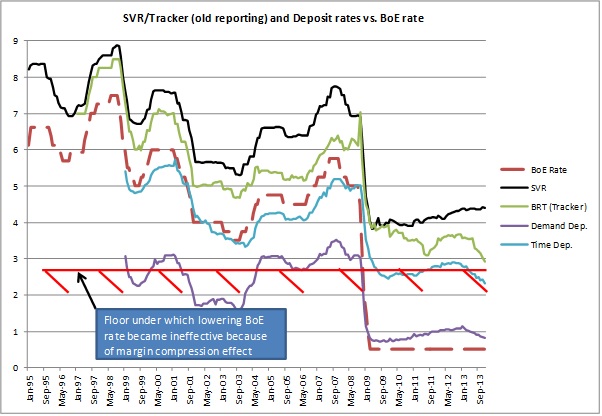
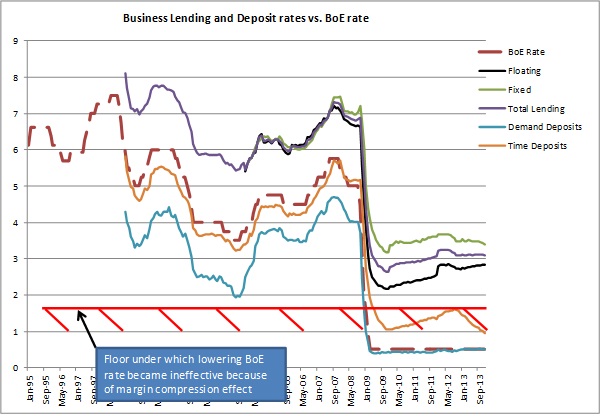
As the UK experience seems to show, banks stopped passing BoE rate cuts on to customers around a 2% BoE rate threshold. I called this phenomenon the ‘2%-lower bound’. I have yet to take a look at other countries.
Enter P2P lending.
By directly matching savers and borrowers and/or slicing and repackaging parts of loans, P2P platforms cut much of banks’ vital cost base. P2P platforms’ online infrastructure is much less cost-intensive than banks’ burdensome branch networks. As a result, it is well-known that both P2P savers and borrowers get better rates than at banks, by ‘cutting the middle man’. This is easy to explain using the equations described above, as costs approach zero in the P2P model. This is what Simon Cunningham called “the efficiency of Peer to Peer Lending”. As Simon describes:
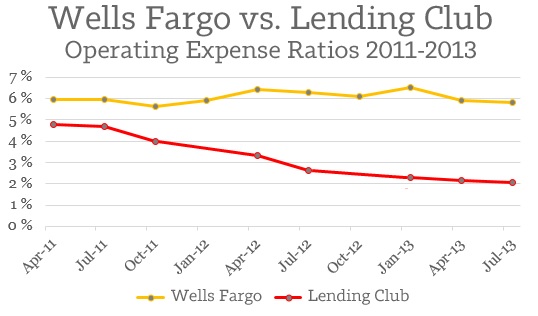
Looking purely at the numbers, Lending Club does business around 270% more efficiently than the comparable branch of a major American bank
Simon calculated the ‘efficiency’ of each type of lender by dividing the outstanding loans of Wells Fargo and Lending Club by their respective operational expenses (see chart below). I believe Lending Club’s efficiency is still way understated, though this would only become apparent as the platform grows. The marginal increase in lending made through P2P platforms necessitates almost no marginal increase in costs.
Perhaps P2P platforms’ disintermediation model could lubricate the banking channel of monetary policy the closer central banks’ base rate gets to the zero bound?
Possibly. From the charts above, we notice that the spread between savings rates and lending rates that banks require in order to cover their costs range from 2 to 3.5%. This is the cost of intermediation and maturity transformation. Banks hire experts to monitor borrowers and lending opportunities in-house and operate costly infrastructures as some of their liabilities (i.e. demand deposits) are part of the money supply and used by the payment system.
However, disintermediated demand and supply for loanable funds are (almost) unhampered by costs. As a result, the differential between borrowers and savers’ rate can theoretically be minimal, close to zero. That is, when the central bank lowers its target rate to 0%, banks’ deposit rates and short-term government debt yield should quickly follow. Time deposits and longer-dated government debt will remain slightly above that level. Savers would be incentivised to invest in P2P if the proposed rate at least matches them, adjusting for credit risk.
Let’s take an example: from the business lending chart above, we notice that business time deposit rates are currently quoted at around 1%. However, business lending is currently quoted at an average rate of about 3%. Banks generate income from this spread to pay salaries and other fixed costs, and to cover possible loan losses. Let’s now imagine that companies deposit their money in a time deposit-equivalent P2P product, yielding 1.5%. Theoretically, business lending could be cut to only slightly above 1.5%. This represents a much cheaper borrowing rate for borrowers.
P2P platforms would thus more closely follow the market process: the law of supply and demand. If most investments start yielding nothing, P2P would start attracting more investors through arbitrage, increasing the supply of loanable funds, and in turn lowering rates to the extent that they only cover credit risk.
The only limitation to this process stems from the nature of products offered by platforms. Floating rate products tend to be the most flexible and quickly follow changes in central banks’ rates. Fixed rate products, on the other hand, take some time to reprice, introducing a time lag in the implementation of monetary policy. I believe that most P2P products originated so far were fixed rate, though I could not seem to find any source to confirm that.
In the end, P2P lending is similar to market-based financing. The bond market already ‘cuts the middle man’, though there remains fees to underwriting banks, and only large firms can hope to issue bonds on the financial markets. In bond markets, investors exactly earn the coupon paid by borrowers. There is no differential as there is no middle man, unlike in banking. P2P platforms are, in a way, mini fixed-income markets that are accessible to a much broader range of borrowers and investors.
However, I view both bond markets and P2P lending as some version of 100%-reserve banking. While they could provide an increasingly large share of the credit supply, banks still have a role to play: their maturity transformation mechanism provides customers with a means of storing their money and accessing it whenever necessary. Would P2P platform start offering demand deposit accounts, their cost base would rise closer to that of banks, potentially raising the margin between savers and borrowers as described above.
It seems that, by partly shifting from the banking channel to the P2P channel over time, monetary policy could become more effective. I am sure that Yellen, Carney and Draghi will appreciate.
Bitcoin Burgers in London!
Walking in London yesterday, look at what I found near Bricklane:

This is genius 🙂
Congrats guys for democratising cryptocurrencies!
Regulating problems away doesn’t work
By ‘regulating’ the symptoms one does not cure the underlying disease. A few more examples in the press of this phenomenon that I keep describing:
– It’s no news that banks are being pressurised from all sides by regulation and lawsuits. The results? Banks aren’t that profitable anymore and remuneration stalls or even falls. Victory then? Wait a minute. Bloomberg reports that there is increased demand for young bankers by private equity funds, which are unsurprisingly more lightly regulated. This is part of a bigger trend that sees investors, funding and, as a result, credit, fleeing the traditional banking system towards the higher-yielding shadow banking system.
– The Economist also reports the same rebalancing towards shadow banking in China. I have already called China a ‘Spontaneous Finance Frankenstein’ given its strong, unnatural, regulatory-driven financial sector. This is typical:
China’s cap on deposit rates at banks is causing money to flood into shadow-banking products such as those offered by “trust” companies in search of higher yields. Offerings by internet firms, with their large existing customer bases, have opened the spigots wider. […]
Some see these online firms as a serious long-term threat to banks and the government’s ability to control the financial sector, prompting noisy demands (mostly by banks) to regulate the upstarts. Regulators have not yet expressed a clear view, but some observers see signals of a looming regulatory crackdown in attacks by the official media; a financial editor on the state-run television network recently branded online financial firms vampires and parasites.
What would be the effects of regulators successfully regulating those various areas of the shadow financial sector? A ‘shadow shadow’ banking sector would emerge. Liquidity, when in abundance, always finds its way. Regulation drives financial innovations, creating systemic risks through complex shadowy interlinked financial products and entities.
One does not regulate symptoms away. Market actors are the only natural, and the best, regulators.
Inside regulator trading
While some people keep praising the virtues of regulation on anything and everything (see Izabella Kaminska here on Bitcoin), a brand new study seems to picture a slightly less rosy view of regulators…
(This research was originally pointed by Lars Christensen on his blog and Facebook account. Thank you again Lars)
The abstract is telling:
We use a new data set obtained via a Freedom of Information Act request to investigate the trading strategies of the employees of the Securities and Exchange Commission (SEC). We find that a hedge portfolio that goes long on SEC employees’ buys and short on SEC employees’ sells earns positive and economically significant abnormal returns of (i) about 4 % per year for all securities in general; and (ii) about 8.5% in U.S. common stocks in particular. The abnormal returns stem not from the buys but from the sale of stock ahead of a decline in stock prices. We find that at least some of these SEC employee trading profits are information based, as they tend to divest (i) in the run-up to SEC enforcement actions; and (ii) in the interim period between a corporate insider’s paper-based filing of the sale of restricted stock with the SEC and the appearance of the electronic record of such sale online on EDGAR. These results raise questions about potential rent seeking activities of the regulator’s employees.
Wait. Do you mean that Securities and Exchange Commission employees are humans like anybody else, driven by their own sense of greed? Amazing.
A few absolutely striking facts were listed in this paper. The SEC lacked a system to monitor employees’ trades until… 2009. Despite the system implemented early 2009, employees seem to be able to avoid large losses by selling their holdings just before a negative SEC decision is announced. Moreover, previous research also found that politicians and congressmen benefited from insider trading… A law was passed in… 2012 to prevent them from trading on privileged information. 2012! They must be kidding. How late is that?! The logic seems to be: impose red tape on corporations ASAP but please do not affect rent-seeking and other benefits of government officials! The effectiveness of the law still has to be researched…
For sure there are some limitations to this paper and its methodology: the authors only effectively analysed 7,200 transactions out of a total of 29,081. This is because many transactions had invalid tickers (some were mutual funds but… how is even this possible for other securities?), were not traded on American exchanges or had very limited data due to illiquidity. Moreover, they couldn’t identify individual employees and as a result worked on an aggregate portfolio. It is also fair to admit that the ‘abnormal return on short positions’ actually didn’t generate any profit but only prevented losses, as they were not short sales but outright ones.
Still, independently of our view of insider trading (many people argue that it isn’t such a bad thing after all), such results are significant and should be further researched. Regulators like to portray themselves as being on a moral high ground, shaming those guilty of insider trading and other frauds. So the news that they may well succumb to the same temptation as those vulgar and immoral capitalist insiders not only sounds very ironic but also reaches extreme levels of cynicism.
As Lars said:
Who is regulating the regulators?
Is the zero lower bound actually a ‘2%-lower bound’?
Following my recent reply to Ben Southwood on the relationship between mortgage rates, BoE base rate and banks’ margins and profitability (see here and here), a question came to my mind: if the BoE rate can fall to the zero lower bound but lending rates don’t, should we still speak of a ‘zero lower bound’? It looks to me that, strictly in terms of lending and deposit rates, setting the base rate at 0% or at 2% would have changed almost nothing at all, at least in the UK.
The culprit? Banks’ operational expenses. Indeed, it looks like the only way to break through the ‘2%-lower bound’ would be for banks to slash their costs…
Let’s take a look at the following mortgage rates chart from one of my previous posts:
From this chart, it is clear that lowering the BoE rate below around 2.5% had no further effect on lowering mortgage rates. As described in my other posts, this is because banks’ net interest income necessarily has to be higher than expenses for them to remain profitable. When the BoE rate falls below a certain threshold that represents operational expenses, banks have to widen the margins on loans as a result.
What about business lending rates? Since business lending is funded by both retail and corporate deposits (and excluding wholesale funding for the purpose of the exercise), the analysis must take a different approach. Banks don’t often disclose the share of corporate deposits within their funding base, but I managed to find a retail/corporate deposit split of 75%/25% at a large European peer, which I am going to use as a rough approximation to estimate banks’ business lending margins. Here are the results of my calculations (first chart: margin over time deposits, second chart: margin over demand deposits):

 No surprise here, the same margin compression effect appears as a result of the BoE rate collapsing (as well as Libor, as floating corporate lending is often calculated on a Libor + margin basis, unlike mortgages, which are on a BoE + margin basis). Before that period, changes in the BoE and Libor rates had pretty much no effect on margins. After the fall, banks tried to rebuild their margins by progressively repricing their business loan books upward (i.e. increasing the margins over Libor).
Here again we can identify a 1.5% BoE rate floor, under which lowering the base rate does not translate into cheaper borrowing for businesses:
This has repercussions on monetary policy. The banking/credit channel of monetary policy aims at: 1. easing the debt burden on indebted household and businesses and, 2. stimulating investments and consumption by making it cheaper to borrow. However, it seems like this channel is restricted in its effectiveness by banks’ ability in passing the lower rate on to customers. Banks’ short-term fixed cost base effectively raises the so-called zero lower bound to around 2%. The only way to make the transmission mechanism more efficient would be for banks to drastically improve their cost efficiency and have assets of good-enough quality not to generate impairment charges, which is tough in crisis times. Unfortunately, there are limits to this process, and a bank without employee and infrastructure is unlikely to lend in the first place…
Don’t get me wrong though, I am not saying that lowering the BoE rate (and unconventional monetary policies such as QE) is totally ineffective. Lowering rates also positively impact asset prices and market yields, ceteris paribus. This channel could well be more effective than the banking one but it isn’t the purpose of this post to discuss that topic. Nevertheless, from a pure banking channel perspective, one could question whether or not it is worth penalising savers in order to help borrowers that cannot feel the loosening.
PS: I am not aware of any academic paper describing this issue, so if you do, please send me the link!
Balkanise or globalise banking, there is no middle way
The Fed published new rules last week that effectively require foreign banks in the US to follow the same rules as American ones, including the recent Dodd-Frank Act. Foreign banks will have to adapt their legal structure and ‘adequately’ capitalise their subsidiaries in order to comply with local capital and liquidity requirements as well as local stress tests. Before that, most banks relied on their foreign parent for liquidity and capital support if needed. I don’t really welcome such changes for a few reasons.
First, it balkanises banking, in an era of globalisation, during which global multinational companies as well as large SMEs look for financing throughout the world to grow their activities. Banks that have global operations provide a single entry point to such firms, smoothening relationship, Know-Your-Customer processes and enhancing financing speed and reliability. Companies can quickly raise funds in Germany or in Latin America without having to rebuild a new relationship (and to deposit funds) with another local (and potentially weaker) bank. As the EU has already pointed out, this move by the Fed also invites retaliation by other regulators around the world. This could trigger a chain reaction not dissimilar to post-1929 tariff battles. Capital flows, foreign investments and economic growth would be the first ones to suffer. People would follow.

Nevertheless, the Fed might have a point in that it would reduce financial instability…in the US… in the short term. However, this is exactly why global authorities were currently working together to make sure that common frameworks were in place to resolve failing banks and ensure similar regulations were applied across various jurisdictions. The Fed’s decision undermines the trust and all the work that had been done so far. It is also the proof that regulators will often tend to defend their own narrow national interests, and the source of their power, rather than the broader ‘greater good’.
Finally, such a decision might even eventually create further instability. Large non-American banks, already under pressure from their shareholders and own national regulators, are now reviewing their US activities in order to figure out ways to circumvent the rules. Some banks already book a part of their US business in Europe. Expect this trend to accelerate and the balance sheet of some emerging markets subsidiaries to grow… In the end, the Fed’s new rules may well lead to further regulatory arbitrage, making banks’ balance sheets even more opaque to external observers, undermining the market process and its necessary overseeing mechanism. And even if isolated and ring-fenced, when the global financial system collapses, the US system is likely to follow.
Photo: Parliament.uk
News digest: Scotland, CoCos and electronic trading
Sam Bowman had a very good piece on the Adam Smith Institute blog about Scotland setting up a pound Sterling-based free banking system unilaterally (yeah I know I keep mentioning this blog now, but activity there seems to have been picking up recently). It draws on George Selgin’s post and is a very good read. One particular point was more than very interesting in the context of my own blog (emphasis added):
George Selgin has pointed to research by the Federal Reserve Bank of Atlanta about the Latin American countries that unilaterally use the dollar. Because these countries – Panama, Ecuador and El Salvador – lack a Lender of Last Resort, their banking systems have had to be far more prudent and cautious than most of their neighbours.
Panama, which has used the US Dollar for one hundred years, is the most useful example because it is a relatively rich and stable country. A recent IMF report said that:
“By not having a central bank, Panama lacks both a traditional lender of last resort and a mechanism to mitigate systemic liquidity shortages. The authorities emphasized that these features had contributed to the strength and resilience of the system, which relies on banks holding high levels of liquidity beyond the prudential requirement of 30 percent of short-term deposits.”
Panama also lacks any bank reserve requirement rules or deposit insurance. Despite or, more likely, because of these factors, the World Economic Forum’s Global Competitiveness Report ranks Panama seventh in the world for the soundness of its banks.
I don’t think I have anything to add…
SNL reported yesterday that Germany’s laws seem to make the issuance of contingent convertible bonds (CoCos) almost pointless. This is a vivid reminder of my previous post, which highlighted some of the ‘good’ principles of financial regulation and which advocated stable, simple and clear rules, a position I have had since I’ve opened this blog. All authorities and regulators try to push banks (including German banks) to boost their capital level, which are deemed too low by international standards. CoCos, which are bonds that convert into equity if the bank’s regulatory capital ratio gets below a certain threshold, are a useful tool for banks (as it allows them to prevent shareholder dilution by issuing equity) and investors (whose demand is strong as those bonds pay higher coupon rates). Yet lawmakers, who love to bash banks for their low level of capitalisation, seem to be in no hurry to provide a clear framework that would allow to partially solve the very problems they point at in the first place… This is a very obvious example of regime uncertainty. As one lawyer declared:
One thing is clear: Nothing is clear
Bloomberg reports that FX traders are facing ‘extinction’ due to the switch to electronic trading. In fact, this has been ongoing for now several years, with asset classes moving one after another towards electronic platforms. Electronic trading now represents 66% of all FX transactions (vs. 20% in 2001). Traditional traders are going to become increasingly scarce and replaced by IT specialists that set and programme those machines. Overall, this should also mean less staff and a lower cost base for banks that are still plagued by too high cost/income ratios. Part of this shift is due to regulation, which makes it even more expensive to trade some of those products. This only reinforces my belief that regulation is historically one of the primary drivers of financial innovation, from money market funds to P2P lending…
Some ‘good’ principles of financial regulation
Readers of this blog know the extent of my love for banking regulation. I love regulation. I really do. Otherwise I wouldn’t have much to write about.
Irony aside, I recently read a very good paper by Calomiris (Financial Innovation, Regulation, and Reform, 2009, which you can find here) that made me give regulation a rethink (to be frank, I was disappointed that there’s not much about financial innovation in this paper, but the rest is pretty good).
Calomiris is a free-market guy. He makes it clear is most of his papers, this one included:
The risk-taking mistakes of financial managers were not the result of random mass insanity; rather they reflected a policy environment that strongly encouraged financial managers to underestimate risk in the subprime mortgage market. Risk-taking was driven by government policies; government’s actions were the root problem, not government inaction.
He is right. But he also seems to be a ‘realist’ (if ever this really means anything). He considers that, given our current distortive institutional framework, the best thing we can do is to mitigate its effect through proper regulation. He writes:
If there were no governmental safety nets, no government manipulation of credit markets, no leverage subsidies, and no limitations on the market for corporate control, one could reasonably argue against the need for prudential regulation. Indeed, the history of financial crises shows that in times and places where government interventions were absent, financial crises were relatively rare and not very severe.
[…But] it is not very helpful to suggest only regulatory changes that are very far beyond the feasible bounds of the current political environment. […] Absent the elimination of [all the policies described above], government prudential regulation is a must.
In a way, he has a point. Whereas I’d like to see the implementation of a free banking system, I also have to admit that this possibility is pretty unlikely to ever reoccur (unless a once in a thousand years financial collapse suddenly strikes). Which led me to think about a ‘second best’. This ‘second best’ solution should follow the principles I described here (where I argued in favour of a stable rule set and regulatory framework) and here (where I agreed with Lars Christensen and John Cochrane and argued against macro-prudential regulations). This is what I wrote:
Stable rules are a fundamental feature of intertemporal coordination between savers and borrowers, between investors and entrepreneurs. In order for economic agents to (more or less) accurately plan for the future, for entrepreneurs to develop their business ideas and anticipate future demand, for savers to invest their money and know that their property rights are not going to disappear overnight and accordingly plan their own delayed consumption and provide entrepreneurs with directly available funds, the economic system needs a stable and predictable rule framework. Production and investments take time and as a result involve uncertainty, which should not be exacerbated by an instable rule set. The rule of law is part of this framework. Monetary policy, financial regulation and government policies should follow the same pattern, instead of being discretionary.
What I am about to describe is a non-exhaustive list of ‘good’ principles of regulation that fit (to an extent) a free-market framework. I may update the list over time. Following the principles above, and even though not perfect, a ‘second best’ solution would have to be:
- As least distortive as possible (i.e. introducing as few loopholes and incentives to game the rules as possible)
- As stable as possible (i.e. no discretionary powers), and
- As simple, transparent and clear as possible (i.e. a few clear and straightforward rules are better than a multitude of obscure and complex ones)
On the monetary policy side, despite its flaws, NGDP targeting seems to be the only ‘easily implementable’ policy that meets the three criteria. I won’t discuss it here (see The Money Illusion, The Market Monetarist, Worthwhile Canadian Initiative, and many other blogs for more information). On the slightly ‘less easily implementable’ side, the ‘productivity norm’ would nonetheless be an even better alternative (see George Selgin’s implementation here, from page 64 onwards).
What about financial and banking regulation? In order to respect the three fundamental rules described above, regulators should:
- Define few transparent, straightforward limits and ratios based on objective and easily measurable criteria that are neither pro- nor counter-cyclical
- Not impose their own perception of risk to the market
- Not vary regulatory limits and requirements over time
- Not publicly shame financial institutions that respect regulatory requirements even if borderline-compliant: the regulators’ role is to make sure that institutions respect the requirements, period
- Publicly make clear that regulations only represent minimums, that regulators are only here to make those minimums respected, and that it is the role of market actors to identify stronger from weaker institutions within those regulatory-defined limits
- Not interfere with financial institutions’ strategy and internal organisational structures: harmonising business models takes the risk of weakening the whole system
- Refrain from making any comment unrelated to the (non)compliance of institutions to regulatory requirements
- Allow the market process to run its course and not institutionalise moral hazard by implementing bailout and other backstop mechanisms
Banking regulation is divided into micro-prudential and macro-prudential regulation. The former provides individual banks with rules they have to respect at all times, independently of the performance of the whole economy. The latter provides all banks with rules that vary according to the state of the economy, independently of the performance of each bank. Following the principles above, fixed and straightforward sets of micro-prudential regulations may be acceptable. On the other hand, most macro-prudential regulations would be eliminated given their discretionary component and their variability over time. It is indeed very hard for regulators to identify bubbles and other excesses (see White, 2011, here). They have a poor track record at it. Discretion could well prevent a bubble from growing too much but it could also prevent a genuinely growing market to reach its full potential. Regulators suffer from the central planner’s problem. As Hayek said in his essay The Use of Knowledge in Society:
The peculiar character of the problem of a rational economic order is determined precisely by the fact that the knowledge of the circumstances of which we must make use never exists in concentrated or integrated form, but solely as the dispersed bits of incomplete and frequently contradictory knowledge which all the separate individuals possess.
I can already hear the rebuttals: “but counter-cyclical macro-prudential policies would help mitigate the bust after the boom!” To which I would respond: “how do you identify a ‘boom’?” For a bust to occur, a boom must be unsustainable. Solid and sustainable growth may well happen and should not be interfered with by counter-cyclical regulations that would in fact not be counter-cyclical at all in this case. Nominal stability is primarily the role of monetary policy, which should promote a stable framework to the real economy. An unsustainable boom is likely to emanate from nominal instability. The goal of regulation is not to mitigate the effects of destabilising monetary policies.
Of course, this does not mean that one should not strive to reduce political and regulatory distortions. ‘Idealists’ (if ever this also means anything) are a necessary part of a healthy democratic process. Moreover, too much compromise can be dangerous: where to fix the limit? Because the very distortive sources are still present, crises can still occur and provide extra arguments to further expand the regulatory burden.
PS: I’ll provide examples of regulations that comply or not with those principles in a subsequent post. This post would have been too long otherwise!
A clarification on mortgage rates for ASI’s Ben Southwood
Ben Southwood from the Adam Smith Institute replied to my previous post here. I am still confused about Ben’s claim that the spread varied “widely”. As the following chart demonstrates, the margins of SVR, tracker and total floating lending over the BoE base rate remained remarkably stable between 1998 and 2008, despite the BoE rate varying from a high 7.5% in 1998 to a low of 3.5% in 2003:

Everything changed in 2009 when the BoE rate collapsed to the zero lower bound. Following his comments, I think I need to address a couple of things. Two particular points attracted my attention. Ben said:
If other Bank schemes, like Funding for Lending or quantitative easing were overwhelming the market then we’d expect the spread to be lower than usual, not much higher.
His second big point, that the spread between the Bank Rate and the rates banks charged on markets couldn’t narrow any further 2009 onwards perplexes me. On the one hand, it is effectively an illustration of my general principle that markets set rates—rates are being determined by banks’ considerations about their bottom line, not Bank Rate moves. On the other hand, it seems internally inconsistent. If banks make money (i.e. the money they need to cover the fixed costs Julien mentions) on the spread between Bank Rate and mortgage rates (i.e. if Bank Rate is important in determining rates, rather than market moves) then the absolute levels of the numbers is irrelevant. It’s the spread that counts.
It looks to me that we are both misunderstanding each other here. It is indeed the spread that counts. But the spread over funding (deposit) cost, not BoE rate! (Which seems to me to be consistent with my posts on MMT/endogenous money.) Let me clarify my argument with a simple model.
Assumptions:
- A medium-size bank’s only assets are floating rate mortgages (loan book of GBP1bn). Its only source of revenues is interest income. The bank maintains a fixed margin of 1% above the BoE rate but keeps the right to change it if need be.
- The bank’s funding structure is composed only of demand deposits, for which the bank does not pay any interest. As a result, the bank has no interest expense.
- The bank has a 100% loan/deposit ratio (i.e. the bank has ‘lent out’ the whole of its deposit base and therefore does not hold any liquid reserve).
- The bank has an operational cost base of GBP20m that is inflexible in the short-term (not in the long-term though there are upwards and downwards limits) and no loan impairment charge.
Of course this situation is unrealistic. A 100% loan/deposit bank would necessarily have some sort of wholesale funding as it needs to maintain some liquidity. It would also very likely have a more expensive saving deposit base and some loan impairment charges. But the mechanism remains the same therefore those details don’t matter.
In order to remain profitable, the bank’s interest income has to be superior to its cost base. Moreover, the bank’s interest income is a direct, linear function, of the BoE rate. The higher the rate, the higher the income and the higher the profitability. As a result, the bank’s profitability obeys the following equation:
Net Profit = Interest Income – Costs = f(BoE rate) – Costs,
with f(BoE rate) = BoE rate + margin = BoE rate + 1%.
Consequently, in order for Net Profit > 0, we need f(BoE rate) > Costs.
Now, we know that the bank’s cost base is GBP20m. The bank must hence earn more than GBP20m on its loan book to remain profitable (which does not mean that it is enough to cover its cost of capital).
The BoE rate is 2%, making the rate on the mortgage book of the bank 3%, leading to a GBP30m income and a GBP10m net profit. Almost overnight, the BoE lowers its rate to 0.5%. The bank’s loan book’s average rate is now 1.5%, and generates GBP15m of income. The bank is now making a GBP5m loss. Having inflexible short-term costs, it’s only way of getting back to profitability is to increase its margin by at least 0.5%. The bank’s net profit profile is summarised by the following chart:

However, a more realistic bank would pay interest on its deposit base (its funding). Let’s now modify our assumptions and make that same bank entirely demand deposit-funded, remunerated at a variable rate. The bank pays BoE rate minus a fixed 2% margin on its deposit base. As a result, what needs to cover the banks operational costs isn’t interest income but net interest income. The bank’s net profit equation is now altered in the following way:
Net Profit = Net Interest Income – Costs
Net Profit = Interest Income – Interest Expense – Costs
Net Profit = f1(BoE rate) – f2(BoE rate) – Costs
with f1(BoE rate) = BoE rate + margin = BoE rate + 1%,
and f2(BoE rate) = BoE rate – margin = BoE rate – 2%.
The equation can be reduced to: Net Profit = 3% (of its loan book) – Costs, as long as BoE rate >= 2% (see below).
Let’s illustrate the net profit profile of the bank with the below chart:
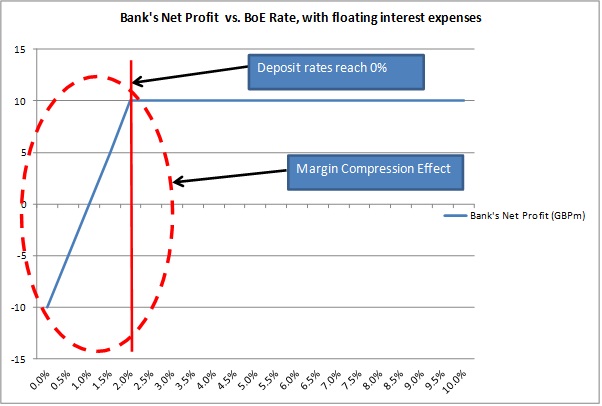
What happens is clear. Independently of its effects on the demand for credit and loan defaults, the BoE rate level has no effect on the bank’s profitability. Everything changes when deposit rates reach the zero lower bound (i.e. there is no negative nominal rate on deposits), which occurs before the BoE rate reaches it. From this point on, the bank’s interest income decreases despite its funding cost unable to go any lower. This is the margin compression effect that I described in my first post. In reality, things obviously aren’t that linear but follow the same pattern nevertheless.
Realistic banks are also funded with saving deposits and senior and subordinated debt, on which interest expenses are higher. This is when schemes such as the Funding for Lending Scheme kicks in, by providing cheaper-than-market funding for banks, in order to reduce the margin compression effect. The other way to do it is to reflect a rate rise in borrowers’ cost, while not increasing deposit rates. This is highly likely to happen, although I guess that banks would only partially transfer a rate hike in order not to scare off customers.
Overall, we could say that markets determine mortgage rates to an extent. But this is only due to the fact that banks have natural (short-term) limits under which they cannot go. It would make no sense for banks not to earn a single penny on their loan book (and they would go bust anyway). Beyond those limits, the BoE still determines mortgage rates.
Although I am going to qualify this assertion: the BoE roughly determines the rate and markets determine the margin. At a disaggregated level, banks still compete for funding and lending. They determine the margins above and below the BoE rate in order to maximise profitability. They, for instance, also have to take into account the fact that an increase in the BoE rate might reduce the demand for credit, thereby not reflecting the whole increase/decrease to customers as long as it still boosts their profitability. Those are some of the non-linear factors I mentioned above. But they remain relatively marginal and the aggregate, competitively-determined, near-equilibrium margin remains pretty stable over time as demonstrated with the first chart above.
With this post I hope to have clarified the mechanism I relied on in my previous post, but feel free to send me any question you may have!
Mortgage rates are still determined by the BoE
Ben Southwood from the Adam Smith Institute wrote an interesting piece this week. I have an objection to his title and the conclusion he reached. Ben wrote:
However, it was recently pointed out to me that since a high fraction of UK mortgages track the Bank of England’s base rate, a jump in rates, something we’d expect as soon as UK economic growth is back on track, could make mortgages much less affordable, clamping down on the demand for housing.
This didn’t chime with my instincts—it would be extremely costly for lenders to vary mortgage rates with Bank Rate so exactly while giving few benefits to consumers—so I set out to check the Bank of England’s data to see if it was in fact the case. What I found was illuminating: despite the prevalence of tracker mortgages the spread between the average rate on both new and existing mortgage loans and Bank Rate varies drastically.
Wait. I really don’t reach the same conclusion from the same dataset. This is what I extracted from the BoE website (using the BoE’s old reporting format, as the new one only started in 2011):

Banks and building societies offer two main types of floating rate mortgages: standard variable rate (SVR) and trackers. Trackers usually follow the BoE rate closely. SVR are slightly different: margins above the BoE rate are more flexible. Banks vary them to manage their revenues but usually fix them for an extended period of time before reviewing them again. During the crisis, some banks that had vowed to maintain their SVR at a certain spread angered their customers when this situation became unsustainable due to low base rates. Some banks and building societies made losses on their SVR portfolio as a result and had to break their promise and increase their SVR.
What we can notice from the chart above is clear: since the mid-1990s, it is the BoE that determine both mortgage and deposit rates. Not the market. All rates moved in tandem with the BoE base rate. Still, the linkage was broken when the BoE rate collapsed to the zero lower bound in 2009. And this is probably why Ben declared that
but what is clear is that tracker mortgages be damned, interest rates are set in the marketplace.
I think this is widely exaggerated. Ben missed something crucial here: banks have fixed operational costs. Banks generate income by earning a margin between their interest income (from loans) and interest expense (from deposits and other sources of funding). They usually pay demand deposits below the BoE rate and saving/time deposits at around the BoE rate, and make money by lending at higher rates. From this net interest income, banks have to deduce their fixed costs (salaries and other administrative expenses) and bad debt provisions.
There is a problem though. Setting the BoE rate near zero involves margin compression. Banks’ back books (lending made over the previous years) on variable rates see their interest income collapse. Banks’ deposit base is stickier: many saving accounts are not on variable rates. Therefore, there is a time lag before the deposit base reprice (we can see this on the chart above: whereas lending reprices instantaneously when the BoE rate moves, deposits show a lag). Moreover, near the zero bound, the spread between demand deposit rates and the BoE rates all but disappears. The two following charts clearly illustrate this margin compression phenomenon:


It is clear that banks started to make losses when the BoE rate fell, as the margin on the floating rate back book (stock) became negative. Using the new BoE reporting would make those margins look even worse*. To offset those losses, banks started to increase the spread on new lending, leading to a spike on the interest margin of the front book (green line above). Banks can potentially reprice their whole loan book at a higher margin, but this takes time, especially with 15 to 30-year mortgages. Consequently, banks not only increased the spread on new lending, but also decided to break their SVR promises and increase their back book SVR rates (see black line in charts). This usually did not go down well with their customers, but some banks had no choice, having entered the crisis with too low SVRs.
What happens to a bank whose net interest income is negative (assuming it has no other income source)? It reports net accounting losses as it still has fixed operational expenses… Continuously depressed margins explain why banks’ RoE remains low. For banks to report net profits, their net interest income must cover (at least) both operational expenses and loan impairment charges. What Ben identified as ‘market-defined interest rates’ or the ‘spread over BoE’s rate’ from 2009 onwards is simply the floor representing banks’ operational costs, under which banks cannot go… The only other (and faster) way to rebuild banks’ bottom line would be to increase the BoE rate.
A mystery though: why didn’t banks decrease their time deposit rates further? I am unsure to have an answer to that question. A possibility is that the spread between demand and time deposits remained the same. Another possibility is that banks’ time deposit rates remained historically roughly in line with UK gilts rates. Decreasing time deposit rates much below those of gilts would provide savers with incentives to invest their money in gilts rather than in banks’ saving accounts.

What would a rate hike mean? Ben thinks it would have little impact, probably because the spread over BoE seems to show quite a lot of breathing space before the base rate impacts lending rates. I don’t think this is the case. A rate increase would likely push lending rates upwards on bank’s back book (i.e. banks are not going to reduce the spread in order to maintain stable mortgage rates). Why? Banks’ net interest margin and return on equity are still very depressed. Moreover, new Basel III regulations are forcing banks to hold more equity, further reducing RoE. Consequently, banks will seek to rebuild their margin and profitability, making customers pay higher rates to compensate for years of low rates and newly-introduced regulatory measures.
* I am unsure why the BoE changed its reporting and what the differences are, but reported lending rates are much lower than with the old reporting standards. Tracker mortgage rates even seem to be lower than time deposit rates. See below and compare with my first chart. If anybody has an explanation, please enlighten me:

Update: I replaced ‘ceiling’ with ‘floor’ in the post as it makes a lot more sense!
Update 2: Ben Southwood replies here…
Update 3: …and I replied there!
 Spontaneous Finance
Recent Comments